 English
 العربية

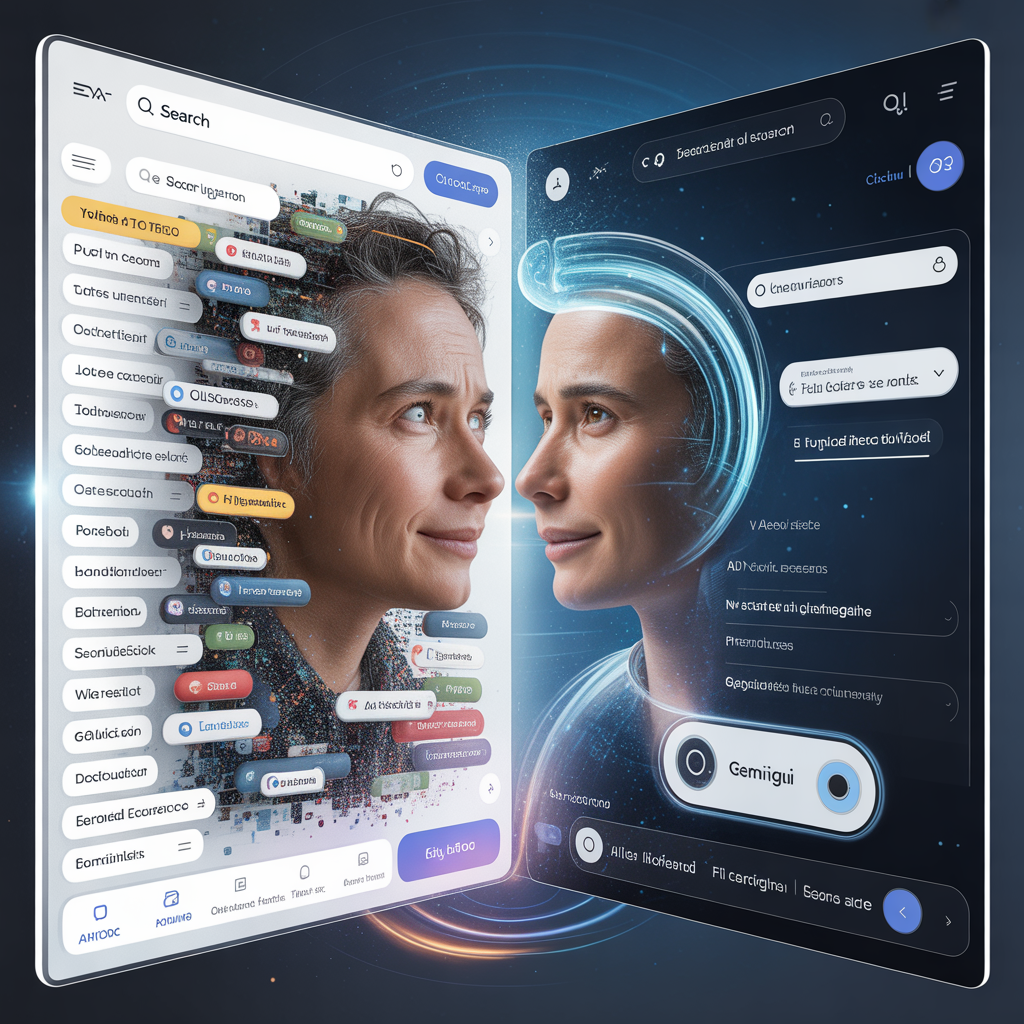
Say goodbye to traditional search engines.
Imagine for a moment that you are looking for complex information, say, the best way to grow tomatoes in a desert climate. In the recent past, you had to open a traditional search engine like Google, type in your question, and then hit the search button. You'll see a long list of links, some for websites and forums, some for scientific articles. You'll spend a lot of time browsing through these links, opening one by one, reading part here and part there, trying to piece together the answer yourself. You may find yourself lost between complex terms or conflicting information, and you may not ultimately come up with a clear and straightforward answer.
Now, imagine the same scenario, but with a tool like Gemini. You write your question, and within a few seconds, you get an integrated and detailed answer, explaining the steps to you clearly, reminding you of the right soil types, the amount of water required, and even the best times to plant and harvest, all in an easy and understandable way. This transformation is not just a simple evolution in the way we search, but a complete reformulation of the concept of access to information. Is the era of keywords and manual search in the sea of links really over? And how have generative AI tools like Gemini changed the rules of the game?
Traditional Search Engines – How Did They Work?
To understand how much change AI tools have made, let's take a quick look at how traditional search engines work. Simply put, these engines were functioning as a huge catalogue of the Internet. When you create a website or write an article, search engines crawl your site, read its content, and then add it to their massive index. This index is very similar to a huge library index, where books are categorized based on the words in them.
When you were searching for something, you were using keywords.If you wanted to search for tomato farming, you type in those words, and the search engine matches them to the words in its index. It then shows you a list of pages that contain these words, sorted by how relevant they are to your keywords and how many links they point to, for example. Your job as a user was to browse through these links, assess their quality, and extract the information yourself. It took effort and time, especially if the information you were looking for required a deep understanding or compilation from multiple sources. These engines were focused on matching words, not necessarily understanding the full meaning or context of your question.
The advent of Gemini and generative AI.
With the advent of generative AI tools like Gemini, we've moved from the information search for information to the answer. It's no longer just about matching keywords, it's about understanding the whole question, knowing the context, and then generating an integrated and straightforward answer. This radical transformation depends on several key points:
-
Natural Language Understanding: The ability to talk to a machine like a human is one of the most prominent features of these tools. You can ask your question in natural language, just like you would talk to someone else, and the tool will understand your intention and answer you accordingly. This removes the barrier between the user and the machine, and makes the search process easier and more effective.
-
Multimodality: Search is no longer just text. Gemini can understand and analyze information from multiple sources such as images, videos, audio recordings, as well as text. This means that you can ask Gemini about the content of a particular image, summarize a long video, or even explain a complex diagram to you. This capability opens up entirely new avenues for research and access to information.
-
Deep Research Feature: One of Gemini's strongest features is its ability to perform deep research for you. Instead of browsing through dozens of links, Gemini does this, gathering information from multiple sources, analyzing it, and then giving you a comprehensive, coherent summary. This saves you a lot of time and effort, and ensures that you get accurate and reliable information from a variety of sources.
How is Gemini redefining access to information?
The impact of Gemini and generative AI tools goes beyond just improving the search process, it is reshaping the way we access and interact with information:
-
Highly personalized: The answers are no longer generic, but highly tailored to your needs and context. If you ask Gemini for a travel plan, it may take into account your past preferences, budget, and even the weather forecast at your destination. This makes the information more relevant and useful to you personally.
-
Effective summarizing: In an age of massive information flow, the ability to summarize long texts has become crucial. Gemini can turn complex research articles, long reports, or even entire books into focused and understandable points in a very short time. This helps you grasp the essence of the information quickly without having to read every detail.
-
Continuous interaction: The research process is no longer just a question and answer. You can ask follow-up questions on Gemini, deepen your understanding of the topic, or ask for additional clarifications. Research turns into an ongoing dialogue, where answers evolve based on your interaction with the tool.
-
Seamless integration: Gemini integrates seamlessly with other Google services you use daily. It can help you plan a trip using Google Maps, summarize emails in Gmail, or even suggest relevant videos on YouTube. This integration creates a unified and efficient experience for accessing information and getting things done.
Challenges and the Other Side of the Picture
Despite the enormous potential that generative AI tools offer, there are some important challenges and considerations that we should be aware of:
-
Hallucination Problem: Sometimes, AI tools may provide information that is inaccurate or completely false, but with complete confidence. This phenomenon is known as hallucinations. Therefore, it is very necessary to verify sources, especially when searching for sensitive information or requires high accuracy.
-
The importance of verifying sources: Although Gemini does in-depth research, relying entirely on its answer without verifying sources can be risky. We must develop critical thinking and information-checking skills, even with these advanced tools.
-
Privacy and over-reliance: As the use of these tools increases, concerns arise about data privacy and how it is used. Over-reliance on AI may also affect our abilities to research and think critically independently.
Does all this mean that we will say goodbye to traditional search engines altogether? Traditional search engines will continue to be important for searching for specific sites, comparing product prices, or searching for breaking news. What happens is that tools like Gemini don't replace search engines, but rather integrate them and add a new layer of intelligence and understanding to them. It shifts the research process from just finding to understanding and generation.
After all, we live in an exciting age where the rules of access to information are changing rapidly. Tools like Gemini aren't just new technologies, they're smart partners that help us explore the world of knowledge in ways that weren't possible before. The key is to learn how to use these tools intelligently, while maintaining our ability to think critically and verify information. The future lies not in abandoning research, but in transforming it into an ongoing and productive dialogue with AI.





Comments
Hi! Thanks for sharing this with us.
https://kwork.com/ref/11268055
Add New Comment