
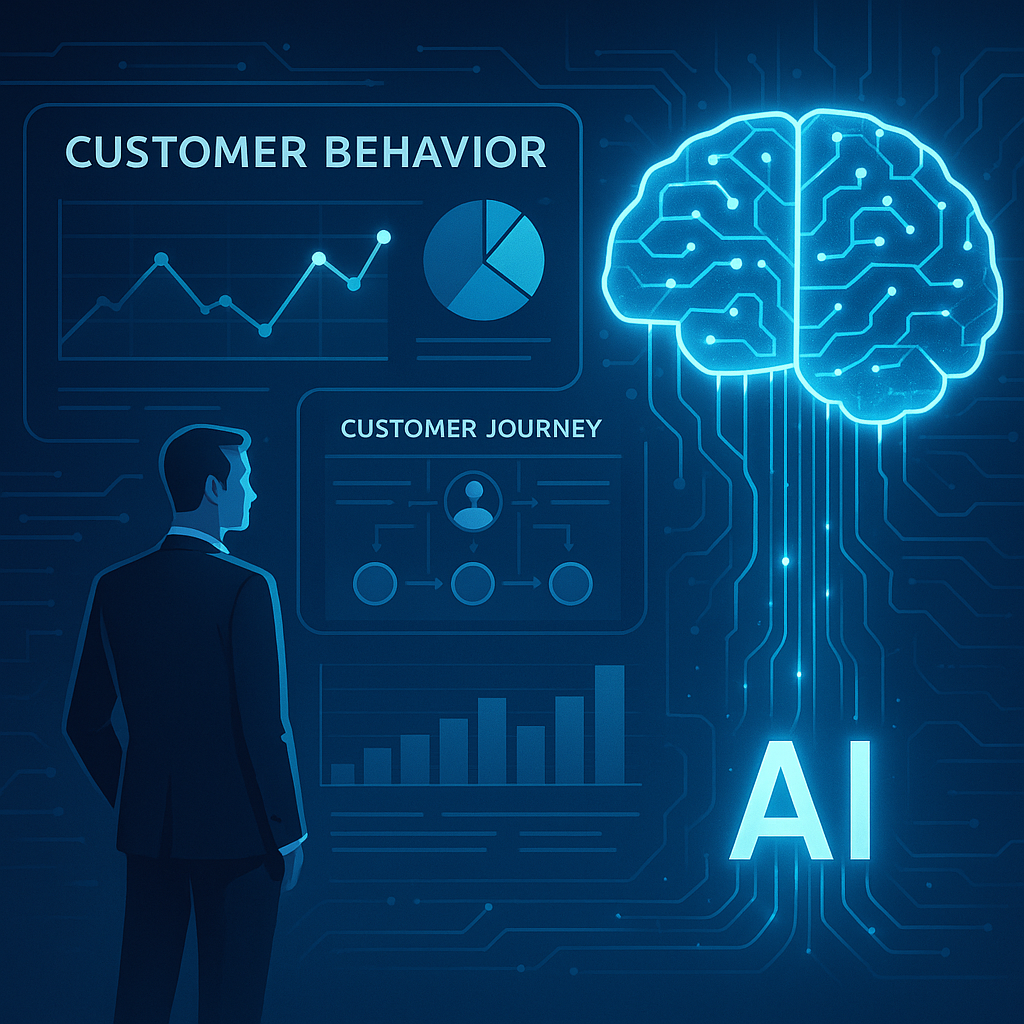
How does AI help you predict customer behavior and increase revenue?
In today's business world, understanding customer behavior deeply is vital to success. It's no longer enough to know who your customer is, it's more important to predict what they'll do, what they want, and when they'll want them. Here AI emerges as a driving force that is transforming the interaction of companies with their markets and changing the rules of the game. The digital revolution has brought about radical transformations, and artificial intelligence is one of its most notable achievements. Understanding customer behavior has become an imperative for sustainable growth in an ever-changing competitive environment. The ability to anticipate customer desires, anticipate their purchasing decisions, and anticipate issues is key to delivering exceptional experiences that build loyalty and increase revenue. In a market full of options, the companies that understand their customers better are the winners. Artificial intelligence comes to offer the solution to this dilemma. With its superior ability to process and analyze large amounts of data, it uncovers hidden patterns and relationships in customer behavior, allowing businesses to anticipate their needs. This article will explore how AI enhances customer behavior prediction and how this translates into a significant increase in revenue, providing a roadmap for success in the age of data and AI.
Artificial Intelligence is Your Window on the Customer's Mind
In the modern business world, the customer is not just a number, but a complex entity whose desires and decisions are intertwined in a vast data network. Understanding this changing entity is the biggest challenge, and this is where AI emerges as a tool and strategic partner, a window that reveals the customer's motivations and aspirations.
Big Data Analysis Imagine
being able to gather every piece of information about your customers: their purchase history, their product browsing, their social media interactions. This is not just data, but a treasure trove of strategic information. But their sheer size and variety make manual processing impossible. This is where artificial intelligence and advanced machine learning technologies come in, with their superior ability to process and analyze big data quickly and accurately. AI combs through this complex data, looking for hidden patterns and relationships. This ability to turn raw data into actionable insights is at the core of the power of AI, enabling businesses to make informed decisions based on a deep understanding of their customers' behavior, reducing risk and increasing the chances of success.
Dynamic Customer Segmentation Say goodbye to static segments
Businesses have long relied on segmenting customers into static segments. But in today's changing world, these segments are no longer enough. AI introduces a revolutionary concept: dynamic segmentation for customers. Instead of placing customers in fixed boxes, AI allows customers to dynamically segment based on their changing behavior in real-time. This means that the customer can move from one segment to another based on their recent interactions or changing interests. This flexibility allows businesses to understand customers more deeply and direct the right marketing messages and offers to them at the right moment, greatly increasing their effectiveness.
Predictive Analysis Future Foresight
The most impactful capability of AI is predictive analysis. By reviewing and analyzing massive amounts of data, AI can provide accurate predictions of customers' future needs, potential behavior patterns, and even problems they may face. This means that businesses can look ahead and take proactive action.AI
can predict which products or services a customer might be interested in based on their past purchases and browsing, enabling businesses to make personalized recommendations that increase the likelihood of a purchase and customer satisfaction. It can also identify customers at risk of leaving before they decide to leave, allowing proactive action to be taken to retain them. This ability to intervene in a timely manner saves significant financial losses and contributes to building long-term relationships. In short, AI acts as an ultra-high-resolution magnifying glass, revealing details of customer behavior, and helping businesses see the big picture and the future. These insights are strategic fuel that drives revenue and ensures business continuity and growth.
Understanding
how AI gives businesses deep insights into the customer, we move on to how to translate these insights into a significant increase in revenue. AI is not just an analytics tool, but a powerful engine that drives economic growth by improving every aspect of the customer journey.
-
Personalizing the experience is the key to loyalty and spending
In the age of endless choices, customers are looking for personalized experiences. AI shines with its ability to achieve this customization at scale. By analyzing behavioral data and individual preferences, it offers highly personalized product recommendations, as do Amazon and Netflix.
This personalization extends to marketing content targeted to each customer, personalized offers and discounts that increase the likelihood of a purchase. These personalized experiences not only increase conversion rates, but also boost long-term customer loyalty, ensuring a continuous stream of revenue. -
Improve marketing campaign targeting
With AI, marketing campaigns become more accurate and effective. Through predictive analysis, the audience that responds most to a particular campaign can be identified, ensuring that the message reaches the right people at the right time.AI
can also choose the most effective marketing channels and improve the timing of messages. This precise targeting reduces budget waste and increases ROI, which directly contributes to increased revenue. -
Sales and customer service
automation Process automation is one of the most prominent uses of AI to increase efficiency, and this reflects positively on revenue. In customer service, chatbots and AI-powered virtual assistants respond instantly to customer queries around the clock, improving their satisfaction and reducing the burden on human support teams. The most sophisticated is predictive customer service, where AI identifies potential issues and delivers proactive solutions. In sales, AI can automate routine tasks such as qualifying leads and scheduling meetings, freeing up sales teams to focus on more complex tasks that require human interaction, thereby increasing their productivity and closing profitable deals. -
Optimizing pricing at the right price at the right time
Pricing is a strategic factor that directly impacts revenue. AI can revolutionize the field by analyzing massive amounts of data related to market factors, demand, competitor prices, and customer behavior, to determine optimal prices in real-time dynamic pricing. This strategy ensures that businesses sell their products at the price that maximizes profits, without losing customers or leaving money on the table. It's a delicate balance that AI can achieve with unparalleled efficiency, significantly boosting revenue and ensuring competitiveness.
Challenges and Recommendations
Despite the enormous potential of AI, its adoption is not without its challenges. Recognizing these challenges and developing strategies to address them is critical to ensure maximum utilization.
-
The importance of data quality and the ethics of using
it. If the data is inaccurate or biased, so will the results. Investing in collecting, cleaning, and standardizing high-quality data is the first step. Businesses must ensure a robust data management infrastructure. Data ethics and customer privacy issues also stand out. Comply with data protection regulations and laws. Being transparent with customers about how their data is being used and getting their explicit consent is vital to building trust and avoiding reputational damage. -
Need for Specialized Expertise Applying
AI solutions requires specialized expertise in data science, machine learning, software engineering, and understanding the business field. Companies may have a hard time finding talent. Collaborating with consulting firms or training existing employees is an effective solution. -
Starting small and gradually scaling
up AI adoption can be overwhelming. It's best to start with small, targeted pilot projects, such as improving product recommendations. This step-by-step approach reduces risk and allows businesses to gain experience, evaluate solutions, and adapt before scaling, ensuring that AI is integrated effectively and sustainably. -
Initial costs and long-term investment
AI solutions may require significant initial investments. But it's important to view it as a long-term strategic investment that returns significant returns in the form of increased revenue, improved efficiency, and customer satisfaction. A careful cost-benefit analysis must be carried out. Cloud-based solutions can also reduce upfront costs and make AI more accessible to a larger number of businesses.
There is no denying that AI has truly revolutionized the business world, offering unprecedented tools to understand and interact with customers effectively. We have moved beyond questioning its impact, and we have entered the stage of making the most of its potential. We've seen how AI enables businesses to turn data into valuable insights, and how dynamic segmentation and predictive analytics enable future foresight. These capabilities extend to be a powerful driver of revenue growth by personalizing experiences, optimizing marketing campaign targeting, automating sales and customer service, and optimizing pricing. It is important to emphasize that AI is not a substitute for the human element, but rather a powerful tool to enhance its capabilities. It frees employees from routine tasks, allowing them to focus on creativity, problem-solving, and building deeper relationships with customers. AI delivers data and insights, while human decision and the human touch remain at the core of true success.