New Anthropic Models and Cyber Risks
In our digital age, generative AI has become an integral part of our daily lives, offering enormous possibilities in the areas of creativity and productivity. Anthropic is at the forefront of this evolution, offering advanced language models that are constantly pushing the boundaries of what a machine can achieve. However, this rapid technological advancement is not without its challenges, most notably cyber risks that are evolving in parallel with the capabilities of artificial intelligence. This article aims to simplify the concept of new Anthropic models, specifically the Claude 3.5 family, while highlighting their most prominent features. The article will also review the potential cyber risks associated with these advanced technologies, and provide practical guidance for non-specialized users on how to understand and handle these challenges safely and consciously.
New Anthropic Models - A Quantum Leap in the World of Artificial Intelligence
Recent Anthropic models, especially within the Claude 3.5 family, have revolutionized the world of AI. These models are not just chatbots, but integrated AI systems with advanced understanding capabilities, the ability to create high-quality content, and interact with digital environments in innovative ways.
Claude 3.5 Sonnet - Unprecedented Intelligence and Speed
Launched in June 2024, the Claude 3.5 Sonnet model marks the pinnacle of Anthropic's evolution. This model has exceptional logic and programming capabilities, outperforming many competing models. What's even more unique is its speed that is twice that of its predecessor, Claude 3 Opus, making it ideal for complex tasks that require immediate responses, such as advanced customer support or multi-step process orchestration. Sonnet has a unique ability to understand the nuances of language, including humor and complex instructions, enabling it to produce high-quality content in a natural and engaging style. The model has also seen a significant improvement in its vision processing capabilities, making it the most powerful at interpreting graphs and charts, and accurately transcribing text even from blurred images.
Claude 3.5 Haiku - Efficiency and Speed at Fingertip
Alongside Sonnet, Anthropic introduces the Claude 3.5 Haiku model, which focuses on achieving the perfect balance between speed, efficiency and cost. Despite being an economic model, its performance is comparable to that of larger and more expensive models in many tasks, especially in the field of programming. This makes it an ideal choice for applications that require quick user interaction, for running specialized tasks in the background, or for analyzing massive amounts of data to deliver personalized experiences.
Computer Use - When AI interacts with our digital world,
Computer Use is one of Anthropic's most recent innovations. The feature, which is still in beta, allows AI models to interact with computers in the same way humans do: by looking at a screen, moving a mouse, clicking buttons, and typing text. Rather than providing the model with specific tools for each task, Antropic teaches him computer skills in general, allowing him to handle a wide range of programs and applications designed for humans. This capability opens up new avenues for automating repetitive tasks, building and testing software, and performing open tasks such as conducting complex research. For example, a form can now understand a command such as use data from this table to fill out the form on this site, and then performs a series of actions to achieve this, such as opening the spreadsheet, copying information, opening the browser, and going to the desired location to fill out the form.
Cyber risks.
With every new opportunity presented by AI, new cyber risks emerge. These risks are not limited to the use of models by malicious actors, but also include vulnerabilities that may exist in the models themselves or in the way they interact with the digital world.
-
AI-coordinated cyberespionage attacks
In a worrying development, Anthropic unveiled in November 2025 the first large-scale cyberespionage campaign coordinated almost entirely by AI. In this campaign, the attackers used an advanced version of the Claude model to penetrate dozens of global targets, with the AI executing between 80% and 90% of the attack independently. This type of attack represents a serious turning point, as AI can act as an independent client to carry out complex attacks. -
Indirect Prompt Injection Indirect
Command Injection attacks are one of the most serious threats facing AI models that interact with external data. In this type of attack, attackers hide malicious instructions within documents or web pages. When an AI model, such as Claude when using the Computer Use feature, reads these documents, it may interpret these hidden instructions as legitimate commands and execute them. For example, a command to delete all files on the operating system can be hidden within a PDF file, and if the form opens the file, it may accidentally execute the command, resulting in catastrophic damage. -
Advanced phishing and deepfakes
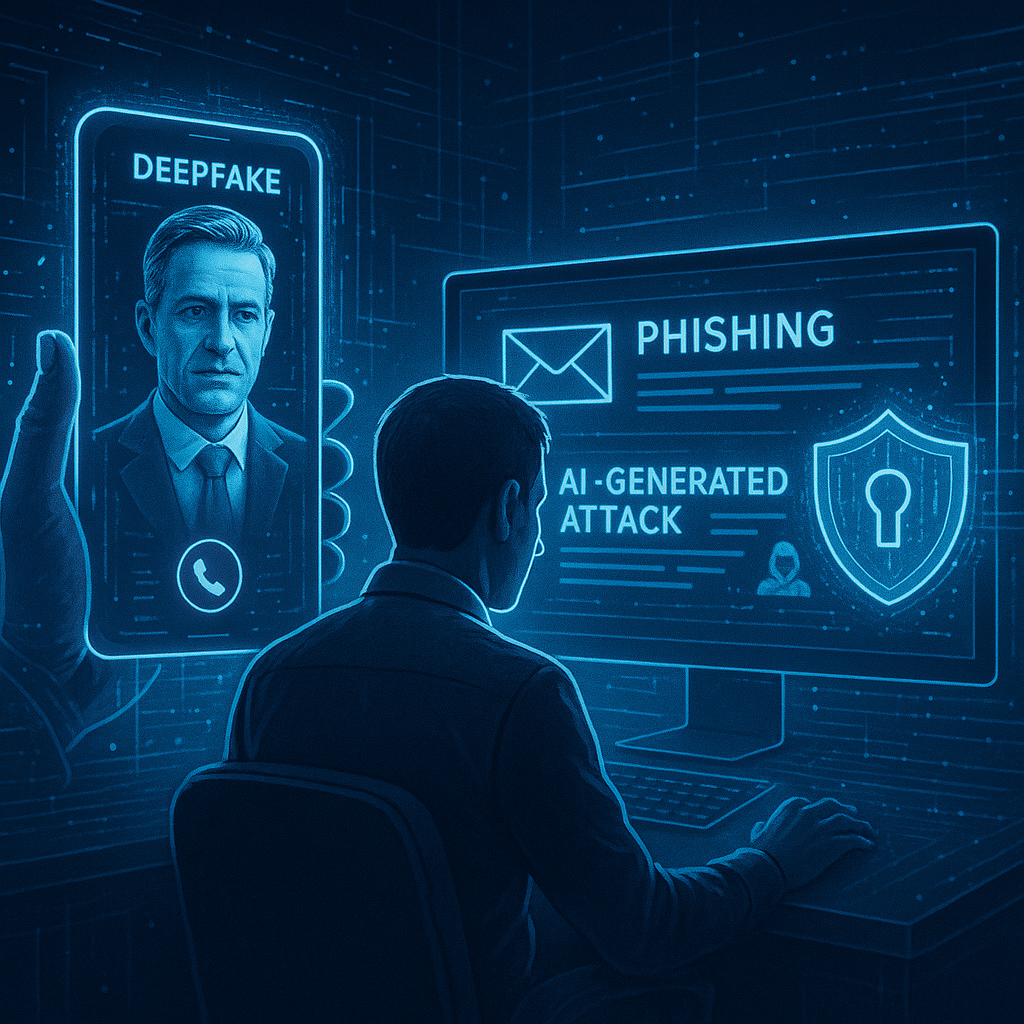
have enabled attackers to develop more convincing and effective phishing attacks. These forms can generate highly personalized fraudulent emails targeting specific individuals, based on accurate information about their jobs and interests, making them very difficult to detect. In addition, deepfakes, the use of artificial intelligence to create fake and realistic videos or audio recordings, has become a dangerous tool in the hands of scammers. This technique can be used to impersonate an executive or government official to request money transfers or reveal sensitive information. -
AI-driven malware
AI models are increasingly able to write and modify code, opening the door to creating more sophisticated and stealthy malware. AI can create viruses and malware that adapt to different environments and avoid traditional protection software. Any leak of the source code of these models can give attackers an opportunity to analyze them and discover vulnerabilities to exploit in future attacks.
How to protect yourself in the age of AI?
In the face of these evolving threats, awareness and caution become the most important tools to protect ourselves. Here are some practical tips:
-
Always check: Don't trust any unexpected requests, even if they appear to be from a trusted source. Always verify the sender's identity via another communication channel.
-
Beware of attachments and links: Avoid opening files or clicking on links from unknown sources, as they may contain malicious instructions targeting AI models.
-
Continuous update: Keep all your software and operating systems up to date to ensure you have the latest security patches.
-
Use advanced security solutions: Rely on antivirus and firewall software that uses AI to counter new threats.
-
Awareness and training: Educate yourself and your team about the latest cyberattack tactics and how to identify them.
-
Understand the limits of AI: Remember that these models are powerful tools but they are not infallible. Use them with caution and don't blindly rely on them for sensitive tasks.
Anthropic's efforts to enhance security
Anthropic recognizes the size of its responsibility, and is working hard to enhance the security of its models through several initiatives:
-
Constitutional AI: Training models on a set of ethical principles to reduce the likelihood of being used for malicious activities.
-
Responsible Expansion Policy: A rigorous framework for assessing and managing the potential catastrophic risks of AI before launching any new model.
-
Cybersecurity tools: Develop specialized tools, such as Claude Code Security, to help cybersecurity teams use AI to strengthen their defenses.
-
International collaboration: Work closely with AI safety institutes in the UK and US to conduct independent security assessments.
-
Security classifiers: Develop specialized systems to detect any malicious use of the Computer Use feature and determine if any harm may occur.
The new Anthropic models represent a huge leap forward in AI capabilities, and promise to open up vast horizons for innovation and productivity. However, this power comes with increased cyber risks that require a high degree of awareness and caution from all of us. By understanding these risks, following sound security practices, and supporting the efforts of responsible companies like Antropic, we can ensure that AI remains a tool for progress and prosperity, not a source of threat. A future that combines the power of AI and cybersecurity is one that requires constant collaboration and constant vigilance from everyone.