
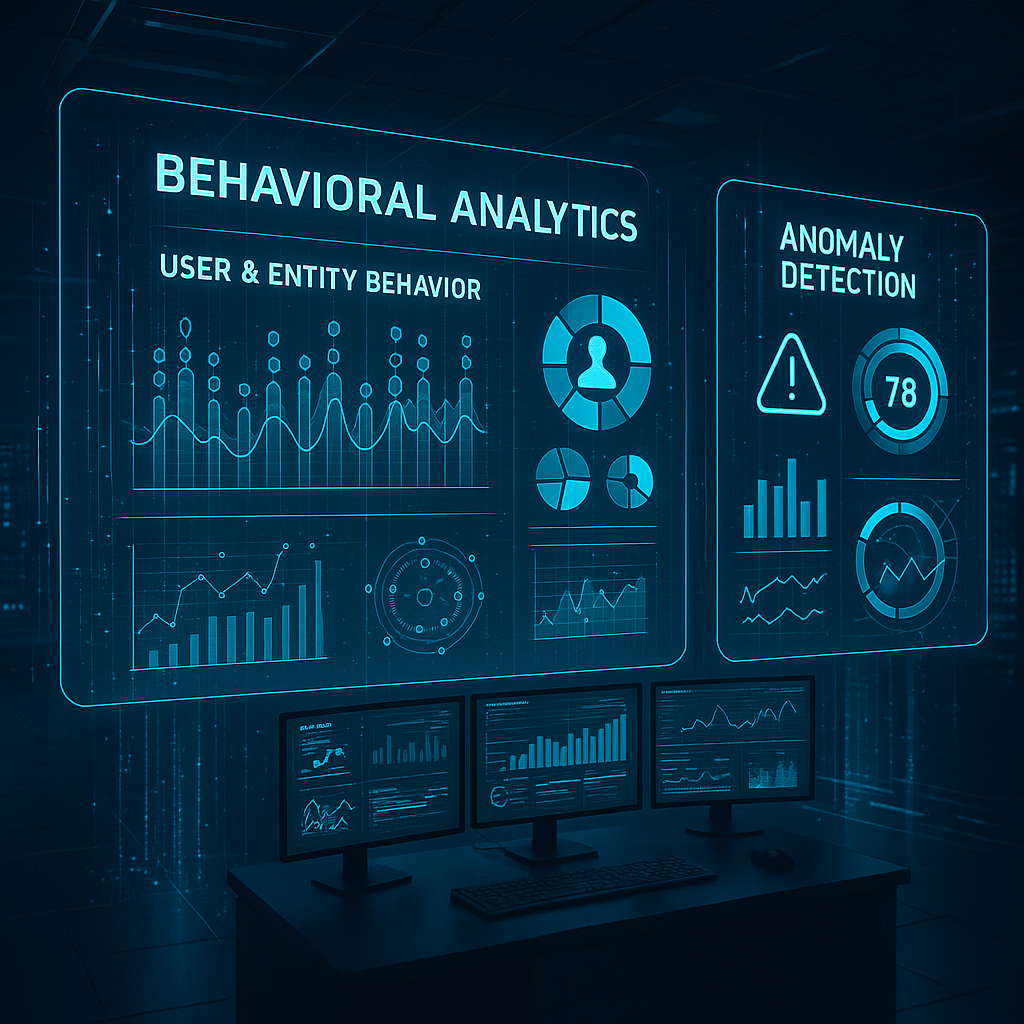
Behavior-based security
In our digital world, data protection has become an ongoing challenge. Traditional cybersecurity has long relied on strict rules to detect known threats. But modern threats often come from within or use trusted credentials. This is where User and Entity Behavior Analytics (UEBA) comes in, revolutionizing protection. It's a smart guard that learns the personality of each user and each device, and detects the threat by changing its behavior. In this article, we'll explain how this smart guard works, and why It has become an absolute necessity to counter insider threats and compromised accounts.
What is UEBA Behavior-Based Security?
To understand UEBA, imagine that you own a bank. Traditional security systems look for known external threats. But UEBA focuses on the threat that comes from within, even if it has access keys.
Behavior-Based Security (UEBA) is an advanced analytics system that uses artificial intelligence and machine learning to monitor and identify the natural behavioral patterns of each employee user and each entity of devices, servers, and applications within the network.
Simplified definition: UEBA is a security technology that builds a behavioral fingerprint for each individual and device, and then monitors any deviation from that footprint, considering it as a potential indicator of risk.
Initially, the concept was called UBA and focused only on humans. But as threats evolved, the letter E Entity – the entity was added to become UEBA, to include monitoring the behavior of devices, servers, and databases, as well as users. This expansion is necessary because attacks often exploit automated accounts and non-human entities.
How does Smart Bouncer work?
The UEBA system operates in a continuous cycle of three main steps:
Step 1: Data collection. Listen to Everything UEBA collects information from every nook and cranny of the organization's network. It doesn't just log in and out, it collects:
-
Logs: When, where, and from what device the user logged in.
-
File access logs: What files have been opened, modified, or deleted.
-
Network logs: The amount of data uploaded or downloaded, and where it went.
-
Email logs: Patterns of sending and receiving messages.
-
HR data: User role, department, and geographic location.
Step 2: Build a baseline learning natural behavior. This is the most important stage. UEBA uses machine learning to analyze the data it has collected, and begins to build the behavioral profile or baseline for each user and entity.
Illustrative example:
Employee Sarah usually works from 9 a.m. to 5 p.m., logs into the sales server from her mobile device, and downloads 50 MB of data per day. This is Sarah's baseline. The accounting server usually communicates with only 3 devices, and backs up the database at 2 a.m. This is the baseline of the server. The AI here doesn't rely on pre-programmed rules, but learns patterns on its own.
Step 3: Detect anomalies and determine the degree of risk of ringing the alarm bell. Once the baseline is established, UEBA begins to monitor the new activity and compare it to the normal pattern. Any deviation is considered an anomaly.
When does the alarm bell ring?
Sarah logs in at 3 a.m. from another country, tries to access HR files which is not her jurisdiction, and downloads 5 GB of data. The accounting server suddenly starts sending encrypted data to an unknown external IP address in the middle of the day. Instead of issuing a simple alarm for each anomaly, UEBA assigns a Risk Score. The more deviations from normal behavior, the higher the risk score, and when a certain threshold is exceeded, a high-priority alert is sent to the security team.
|
Behavior |
Is it an anomaly? |
Is it an anomaly? |
Possible explanation |
|
Sign in from a new device |
Yes |
Low |
You may have bought a new device. |
|
Trying to access confidential files for the first time |
Yes |
Medium |
It could be an attempt to spy or an unintentional mistake. |
|
Download a huge amount of data in an unusual time |
Yes |
high |
Their account may have been compromised or they may be a malicious insider threat. |
Why do we need UEBA in our time?
In the past, cybersecurity was focused on preventing access. Today, the focus is on discovering who is actually inside. UEBA excels at detecting three main types of threats:
Insider Threats
This is the area where UEBA shines. Insider threats can be of two types:
-
Malicious insider threat: A disgruntled employee uses his legitimate powers to steal data, but his behavior suddenly changes such as accessing files that are not necessary for his role.
-
Neglected or Hacker Insider Threat: An employee falls victim to a phishing message, allowing the hacker to take control of their account. The hacker uses valid credentials, but their behavior will be different from the actual employee's behavior such as trying to enter from a different location.
UEBA is the perfect tool to detect these threats because of its focus on how to use the powers.
Compromised Accounts
When a hacker steals a username and password, they get a legitimate key. But the hacker isn't the real employee, and their behavior will inevitably vary. They might try:
-
Access to systems that the employee has never visited before.
-
Change work patterns such as using different communication protocols.
-
Work in the middle of the night or on holidays.
UEBA detects this discrepancy immediately, even if the login data is 100% correct.
Low-and-Slow Attacks
Some attacks don't happen all at once, but develop slowly over weeks or months to avoid detection. A hacker may download a very small amount of data each day, or try to access a new system once a week. These slow patterns are very difficult for traditional rules-based security systems to detect.
UEBA, with its ability to analyze long-term behavior and build accurate baselines, can connect these small dots and determine that this slow behavior is actually a sophisticated attack.
UEBA vs. SIEM Integration No Competition
Some may wonder: isn't this what SIEM does for security information and event management systems?
SIEM Security Information and Event Management is a centralized system that collects logs and alarms from all security devices and applies fixed rules to them such as: If login fails 5 times in one minute, trigger an alarm.
|
Feature |
UEBA Behavior-Based Security |
UEBA Behavior-Based Security |
|
Primary Focus |
Behavior and anomalies |
Records, Events & Rules |
|
Detection mechanism |
Machine Learning and Statistical Analysis |
Static Rules and Known Signatures |
|
Ideal Threat Type |
Insider threats, compromised accounts, anonymous attacks |
Known Viruses, Obvious Hacking Attempts, Compliance |
|
Main Output |
Risk score and behavioral profile |
Alerts based on rules |
-
Integration is key: UEBA doesn't replace SIEM, it adds a layer of intelligence.
-
SIEM tells you: A login failure occurred.
-
UEBA tells you: This login failed occurred at 3 a.m., from an unknown device, for an account that has never failed to log in, and the risk score for this event is 9/10.
UEBA takes data from SIEM and converts it from logs into security-meaningful behavioral stories.
Challenges and the Future
Despite UEBA's immense power, its implementation is not without its challenges:
-
The UEBA
requires massive amounts of data to learn natural behavior, necessitating a robust and costly infrastructure to collect, store, and process it. -
False Positives Noise Challenge
In the early stages, the system may trigger false Positives alarms because the baseline is not yet complete. It takes time and effort from the security team to train the system, improve baseline accuracy, and reduce these alarms. -
Privacy Concerns
Since UEBA monitors every user's every movement, concerns arise about employee privacy. Organizations must be transparent about monitoring and how data is used, and abide by legal regulations to protect privacy.
The future of UEBA and generative AI
The future of UEBA is moving towards deeper integration with generative AI and predictive analysis. The system will not only detect anomalies, but will be able to:
-
Risk Prediction: Identify entities that show early signs of danger before damage occurs.
-
SOAR automated response: Automatically take immediate actions, such as temporarily blocking user access when a risk level exceeds a certain threshold.
-
Complex Context Analysis: Better understand the human context behind behavior to reduce false alarms.
Cybersecurity has moved beyond relying on fixed rules. In the age of insider threats, it's no longer enough to ask: Is this signature known?
UEBA is the answer to this question. It represents a paradigm shift from passive defense to proactive and intelligent surveillance. By building a deep understanding of the behavior of each individual and each entity, UEBA gives you the ability to detect enemies hiding in broad daylight.
Adopting this technology is an investment in security intelligence that ensures that your smart guard knows you and your network.