
Specialized Cloud Computing for AI
In today's world, AI is no longer just science fiction that we see in movies, but a reality that we live in every moment, from recommendations that appear to us on social media platforms, to voice assistants in our phones, to amazing tools that write texts for us and generate images for us in a matter of seconds. The answer lies far from our eyes, in giant data centers known as cloud computing, specifically in a new and sophisticated type of artificial intelligence called specialized cloud computing.
In this article, we will take you on a simple journey to discover together what this technology is, why we need a special cloud for artificial intelligence, and how this technology is changing the face of the world around us, in an easy and clear way away from boring technical complexities, and in a way that suits the reader who wants to understand the essence without drowning in complex engineering details.
The Journey of Evolution:
To understand where we are now, we have to go back a bit. Initially, companies relied on huge computers placed in refrigerated rooms inside their premises. These devices were called local servers. Companies had to buy, maintain, and constantly update these devices, which was very expensive and cumbersome. Then came the traditional cloud computing revolution. The idea of the cloud was simple: Instead of owning the hardware, he rented it from major companies like Amazon or Microsoft online. This cloud was like a public utility, just like the electricity or water grid; you only pay for what you use. This cloud has been successfully running websites, mobile apps, and storing photos and files for many years. However, with the advent of generative AI such as ChatGPT and image generation tools, the world has discovered that the traditional cloud, while powerful, is not ready for this new kind of work. Artificial intelligence doesn't just need a computer, it needs a very special kind of computational power, which has led to the emergence of specialized cloud computing for artificial intelligence.
Why is the regular cloud no longer enough for AI?
Imagine that you want to transport a huge load of sand. You can use hundreds of small cars that represent regular processors, but this will be slow and inefficient. The best is to use a giant truck dedicated to transporting sand that represents specialized treatments. The traditional cloud is mainly based on the so-called CPU CPU. This processor is the mind that is good at performing various tasks one after the other with high precision. It is great for opening websites, writing documents, and managing databases. Artificial intelligence works in a very different way. In order for AI to learn or understand your question, it needs to do billions of simple calculations like multiplication and addition operations at the same time. The average CPU will feel very overwhelmed if they try to do it alone. This is where the GPU comes in. These chips, originally used to make video games look realistic, have been discovered by scientists to be geniuses at performing thousands of simple calculations at once. Artificial intelligence needs an army of these GPUs to work efficiently. Specialized clouds are what provide this huge and organized army.
What makes the AI cloud truly specialized?AI
Specialized Cloud Computing is not just a regular cloud that we have added some devices to, but an infrastructure that has been completely redesigned to suit the needs of digital minds. It features four main columns that make it unique:
-
Powerful Processors Beating Heart
Instead of relying on regular processors, these clouds are filled with thousands of specialized processors. The most famous of these are NVIDIA chips like the H100 and B200, and there are also chips from Google called TPU. These chips aren't intended for office work, but are designed for one purpose: to process the big data that AI needs to learn and deduce. -
Supernets Data Highways
In AI, it's not enough to have powerful devices, these devices must talk to each other at lightning speed. Imagine if you had thousands of smart workers, but they communicate via slow paper mail; they won't get anything done! In the specialized cloud, highly sophisticated connectivity technologies such as InfiniBand are used that allow data to be transferred between devices at breakneck speed and without any lag, making thousands of devices work like one giant device. -
Cooling and Energy Ideal Environment
These mighty processors generate enormous heat and consume a very large amount of energy. Specialized clouds are built in data centers equipped with advanced liquid cooling systems and engineering designs that allow for efficient passage of cold air, to ensure that work continues without downtime or damage to sensitive devices. -
If
you rent a regular cloud, you'll need to spend days or weeks installing software and hardware definition. The specialized cloud comes ready to cook. It provides you with all the software tools that AI developers need, allowing them to start training their models right away.
Who are the players in this field?
Today's AI cloud market is divided into two main categories, each with its own role:
-
Omnistore giants: Amazon AWS, Microsoft Azure, and Google Cloud. These companies are like mega malls; you can find everything from file storage to the most powerful AI devices. Its advantage is high security, and the ability to connect AI to the rest of the company's services easily.
-
Luxury shop specialists: New companies such as CoreWeave, Lambda Labs, and RunPod have emerged. These companies don't care about storing your photos or running your email; they just provide the net computational power of AI. Developers prefer them because they often provide the latest chips faster, and at prices that may be very competitive because they don't have the administrative burdens of giant companies.
How does this technology touch your daily life when you're not a specialist?
All of the above may seem out of your way, but the truth is that you reap the rewards of these specialized clouds almost every hour:
-
In medicine and healthcare: Thanks to these clouds, researchers can analyze millions of medical images such as X-rays in minutes to detect diseases at very early stages. It is also used in drug design, where artificial intelligence simulates how a drug interacts with the human body within the cloud, accelerating the arrival of new treatments to patients by years.
-
In the face of climate change: AI clouds are used to predict the weather with incredible accuracy, simulating natural disasters before they occur, helping governments protect people and reduce losses.
-
In the world of entertainment and creativity: Have you ever used an app that turns your photo into a canvas, or a tool that generates a video from simple text?
-
In economics and business: SMEs no longer need to have huge budgets to have AI. Thanks to the cloud, a small store can use a very smart chatbot to serve its customers, just like large companies, creating equal opportunities for everyone.
Challenges:
Despite all these advantages, specialized cloud computing for AI faces significant challenges that we must know:
-
Power consumption: These data centers consume huge amounts of electricity. There is a race now to make these clouds green by building them next to renewable energy sources such as wind and solar.
-
Global chip shortage: The demand for massive processors like NVIDIA far outstrips supply, making them difficult and sometimes expensive to obtain.
-
Privacy and security: When you put your data in someone else's cloud, there's always a question of how secure that data is. So, today we are seeing a big trend towards the so-called sovereign cloud, where countries build their own clouds within their borders to ensure the security of their information.
The future of AI cloud computing
We are now in 2026, and we see the features of the future clearly:
-
Edge AI: The cloud is no longer limited to remote data centers in the Arctic or deserts. The cloud is getting closer to us, reaching the telecom towers near our homes, making it an instant response to high-speed devices like self-driving cars.
-
Collaboration between clouds: Businesses can now use more than one cloud at the same time, a cloud from Amazon and a cloud from a specialized company, and switch between them seamlessly depending on need and cost, which is called multi-cloud.
-
Tech democracy: Thanks to low costs and the availability of simple tools, anyone with an innovative idea can rent a powerful cyber brain for a few minutes and execute their idea, opening the door to a new generation of innovators and inventors.
The era of the cloud that thinks
specialized cloud computing for AI is not just a fleeting technological development, but the factory where the digital minds of the future are made. It is the infrastructure that underpins our smart cities, our health systems, and our economies in the years to come. The next time you're impressed by a machine's ability to understand you, translate your language, or help you solve a complex problem, remember that there's a specialized supercloud, filled with thousands of powerful processors, that works silently behind the scenes to make it possible. We are not just living in the age of artificial intelligence, we are living in the age of the cloud that thinks, which opens up horizons for us that we never dreamed of before.
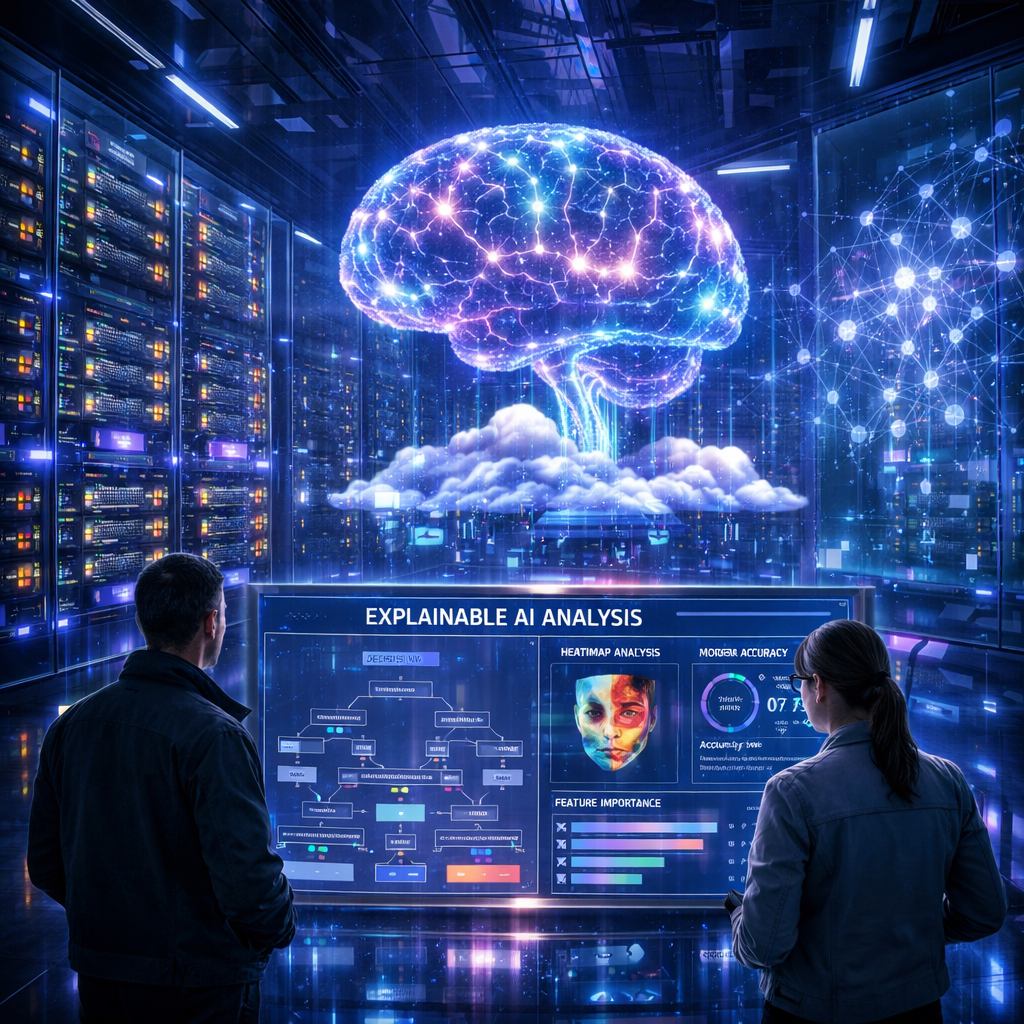
Interpretive AI: Explainable AI
In the past few years, AI has gone from being just an idea in science fiction movies to a reality that touches every detail of our lives. Today, algorithms choose what we watch on YouTube, determine who gets a bank loan, and even help doctors diagnose incurable diseases. But, with this enormous advance, a troubling question has arisen: Why did the machine make this decision?. This question is what Explainable AI or XAI for short is trying to answer. Initially, AI systems relied on explicit and clear human rules. With the advent of machine learning, machines began to learn rules directly from the data, making them so complex that the human mind could no longer track them, which we call the black box. Interpretive AI is essential to regain human control and clarity lost in our most sophisticated tools.
The mystery of the black box
Imagine that you went to the doctor, and after some tests, a sophisticated computer told you that you needed urgent surgery. When I asked the doctor, "Why?" he replied, "I don't know, the device said that and it is 99% accurate."Will you agree to the surgery? Most of us will hesitate. This is the problem of the black box in traditional AI. Modern systems, especially those that rely on deep learning and artificial neural networks, are so complex that even the programmers who designed them may not fully understand how they came to a certain conclusion. It works like a closed box: data enters on one side, results come out on the other, and what happens in the middle remains a mysterious secret. This is where interpretive AI comes into play to turn this black box into a transparent glass box, where we can see the internal processes and understand the logic on which the machine was based.
What is Simply Interpretive AI?
Interpretive AI is not just a new technology, it is a philosophy that aims to make AI systems more visible and transparent to the average user. Instead of giving you a deaf answer like yes or no, the machine gives you an accompanying explanation that says, "I chose yes because factors A and B were high, while factor C was low." In simpler terms, it is an attempt to translate the language of numbers and complex mathematics that a machine understands into simple, logical human language that we can grasp and discuss.
More than a curiosity,
some may wonder: if a machine is accurate and gives correct results, why do we care about how it works?. The truth is that interpretation is not just a luxury, but an imperative for several fundamental reasons:
-
Trust
is the cornerstone of any relationship, whether between humans or between humans and between humans and machines. We cannot fully rely on a system that we do not understand, especially in fateful decisions. When the system explains why it makes a decision, it's easier for us to trust it or even detect when it's wrong. -
Fairness & Bias
AI learns from the data we provide to it. If this data contains previous human biases, such as discrimination against a particular race or gender, the machine will learn and repeat that bias. Without explanation, the regime may reject a woman's employment application simply because she is a woman without us knowing it. Interpretation allows us to detect and correct these biases. -
Legal and Ethical Responsibility In
the event of an accident with a self-driving car, questions arise about legal responsibility. Without explanation, we cannot pinpoint the cause of the accident. Global laws such as the European Union's General Data Protection Regulation (GDPR) are beginning to give individuals the right to interpretation. This means that anyone affected by an automated decision has the right to know the logic followed, ensuring legal and ethical accountability and protecting the rights of individuals from the ambiguity of algorithms. -
Improving and improving the system
When we understand why AI goes wrong, we can fix it. Interpretation helps engineers fine-tune models and make them more accurate and effective.
How does interpretive AI work?
We can divide the methods of interpretation into two levels: the comprehensive interpretation that explains the general logic of the system such as the criteria for the distribution of grades in the school, and the topical interpretation that explains one specific decision such as why a particular student failed. Both are essential to understanding how a machine works at different levels. We don't need to be experts in mathematics to understand the basic principles on which this field technically relies There are two main ways to make AI talk:
First, inherently explainable models
there are types of artificial intelligence that are simple enough for humans to understand directly. Such as Decision Trees. Imagine it as a flowmap: Does the customer have a job? Yes -> Is his income greater than a certain amount? Yes -> then he approved the loan. These models are obvious, but the problem is that they may not be as robust and accurate as complex models for very difficult tasks.
Second: Post-hoc ExplanationsHere we use very complex black box models, and then we come up with an external interpreter who tries to explain what happened
. There are several methods for this, including:
-
Highlight features: In an image recognition system, the system may color the parts of the image that made it decide that this is a dog and not a cat such as the shape of the ears or nose.
-
Counterexamples: The system tells you: You rejected your loan, but if your income was $500 higher, you would have approved it. This kind of explanation is very practical for humans.
Interpretive AI in our real life Let's
take a look at how this technology is changing some of the sensitive sectors:
-
In medicine,
imagine an artificial intelligence system that analyzes X-ray images. Instead of telling the doctor there is a tumor, the system draws a circle around a specific area and says, " I've discovered an abnormal density here that resembles the known patterns of polyps." This allows the doctor to make sure that the device's speech is correct and make the final decision responsibly. -
In finance and banking
, when a young person applies for financing for their small business, and the AI rejects the application, the XAI system will provide a report showing that the reason is insufficient credit history and not any other unfair factor. This protects the bank from discrimination issues and helps the customer know what it needs to improve. -
In the judiciary and security,
some countries use systems to predict the likelihood of offenders returning to commit crimes to assist in parole decisions. Without explanation, these systems could have been catastrophic; studies would later discover that the system gave higher risk scores to people from certain neighborhoods or races, not because they were more criminal, but because the historical data it fed on them were biased. Interpretive AI ensures that the criteria used in the assessment are purely legal and logical, such as a history of actual precedents or behavior inside the prison, and excludes any discriminatory factors that may subtly creep into the black box. -
In self-driving
imagine that you are sitting in a self-driving car, and suddenly the car comes to a hard stop in the middle of an empty road. You will feel scared and confused. However, if a message appears on the screen that says, "I stopped because I spotted a small object moving fast behind that tree, it could be a child running," the fear will turn into a sense of security and gratitude for the car' s intelligence.This is the essence of XAI; it turns confusion into understanding, and doubt into certainty. Without this connection, self-driving cars would remain just scary machines to which we dare not give our lives. -
The biggest challenge
is a dilemma that scientists always face: more accurate models such as deep neural networks are often the least explainable, while easy-to-understand models are less accurate at complex tasks.
The scientists' current goal is to break this rule, and develop systems that combine superintelligence with the ability to explain clearly. We don't want a machine that's so smart but it's silent, we don't want a machine that talks a lot but is stupid; we want a smart and clear digital partner. Moreover, another challenge is the level of interpretation. The explanation that a software engineer needs to fix a system error is very different from the explanation a doctor needs to diagnose a patient, and it is different from the explanation that the patient himself needs to understand his condition. Therefore, interpretive AI must be smart enough to know who is addressing, provide each person with the level of detail that suits them and help them make their decision. This is what we call phased interpretation or contextual interpretation, and it is one of the most exciting areas of current research.
The future of the relationship between humans and artificial intelligence
We are moving from an era where AI was a tool we use, to an era in which it becomes a colleague or an assistant. In any successful fellowship, there must be communication. Interpretive AI is the bridge that will bring a human back to the command center. It does not rob the machine of its power, but rather gives man the ability to supervise and understand it. In the future, we will not accept any intelligent system that cannot explain itself, just as we will not accept an employee who refuses to explain his decisions to his manager.
Towards a more humane AI
Ultimately, interpretive AI is not just a technical challenge, it is an ethical obligation. We make these tools to serve humanity, and no real service can be done in secret or mystery. When we understand why and how, we not only get answers, but we get security, justice, and trust. Making AI explain itself is the first step towards building a future where humans and machines live side by side in harmony, where technology is as powerful as it is clear, and as smart as it is transparent. We are on the cusp of a new revolution, one that is not a revolution in what AI can do, but in how we can understand and control it. Interpretive AI is the golden key to this promising future.