 English
 العربية

Advanced Computer Vision:
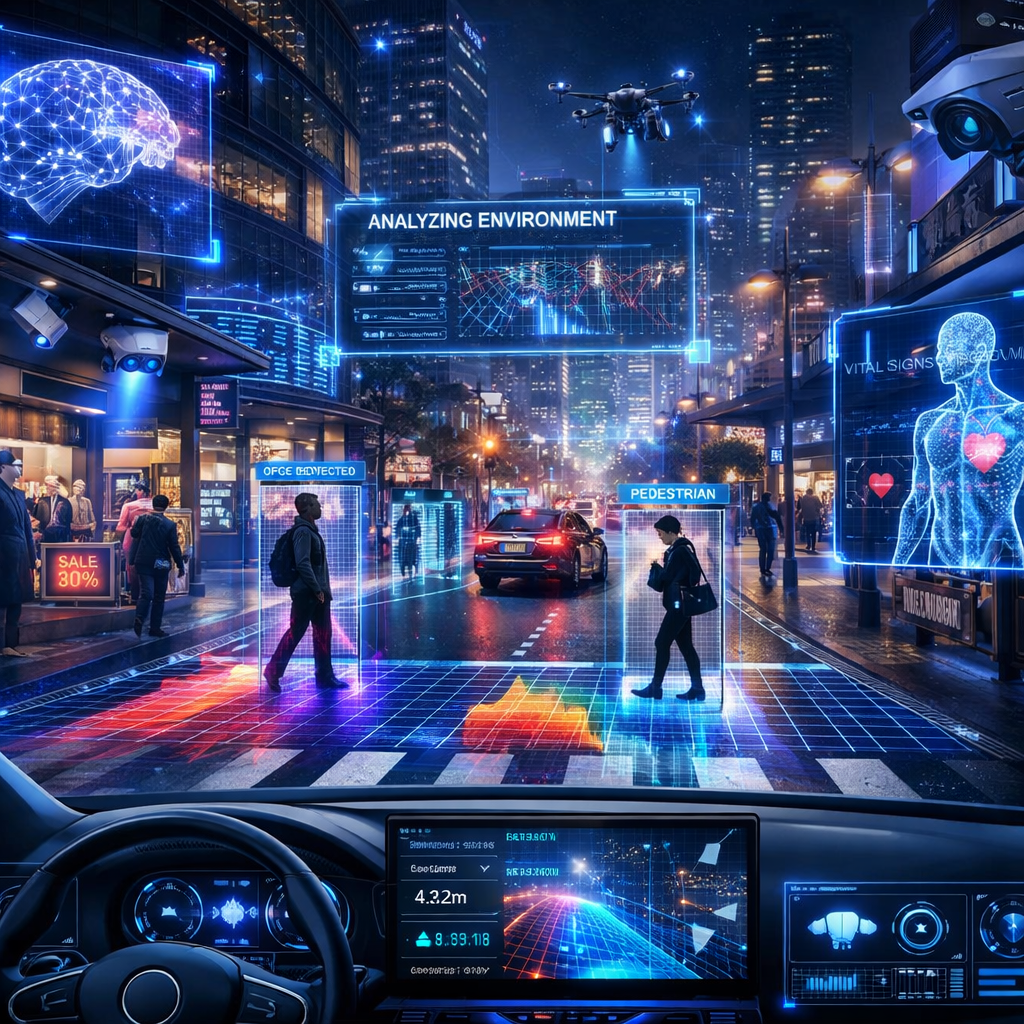
In today's world, technology has become an integral part of our lives, evolving at a rapid pace and opening up new horizons. Computer vision is emerging as one of the most important areas of artificial intelligence that aims to enable machines to see and understand the visual world just like humans, transforming images into understandable information rather than just colors and dots. This technology has evolved from recognizing simple patterns to analyzing complex scenes and tracking motion, in what is now known as advanced computer vision, which has become an essential part of our phones, cars, and healthcare systems. This article aims to simplify the concept of advanced computer vision for non-specialists, explain how these technologies work, their importance, and how they change our lives, as well as review their most prominent applications and the challenges they face.
How does computer vision work?
To understand advanced computer vision, we need to know how to see a machine. Unlike humans, a machine sees an image as a set of numbers called pixels. The job of computer vision is to turn these numbers into meaningful information.
This process is usually done through key steps:
-
Image Capture: The process is initiated by a camera or sensor that captures light and converts it into digital data.
-
Pre-processing: The image is cleaned and quality improved to make it easier to analyze, such as removing noise or adjusting the lighting.
-
Feature extraction: The machine looks for clues in the image, such as edges, colors, or geometric shapes that distinguish objects.
-
Analysis and interpretation: Using complex algorithms, the machine compares the extracted features to huge databases it has been trained on. If she sees face-like features, she interprets it as a human face.
-
Decision-making: Based on the explanation, the machine takes action, such as unlocking the phone or steering a car to avoid an obstacle.
From manual grammar to deep learning
computer vision began in the 1960s with simple attempts to recognize geometric shapes. Initially, scientists programmed the rules manually, which made the systems inflexible. The real leap came with the advent of machine learning, where a machine is able to learn from data instead of following rigid instructions. The breakthrough was the advent of Deep Learning, a branch inspired by the structure of the human brain. This technology uses convolutional neural networks (CNNs) that process information across multiple layers, allowing it to detect complex features automatically and with high accuracy. This is what propelled computer vision into its advanced era, where machines were able to understand context and anticipate events.
Advantages of Advanced Computer Vision
Advanced computer vision is not just a better view, it is a deeper understanding of the world. Here's what sets it apart:
-
Contextual and deep understanding: The machine no longer recognizes objects as separate pieces, but also understands the complex relationship between them and the surrounding environment. For example, an advanced system can distinguish between a person who walks normally and someone who runs in an emergency, or understand that having an open canopy is associated with the likelihood of rain, which helps improve the accuracy of forecasts.
-
3D vision and depth estimation: New technologies go beyond flat images to understand the three-dimensional nature of the world. This means that the machine can accurately estimate distances, and understand the size and shape of objects in space, which is indispensable for robots moving in homes or factories, and for self-driving cars that need to avoid obstacles with millimeter accuracy.
-
Superior real-time analysis: Thanks to powerful processors, advanced systems can analyze hundreds of frames of video per second. This allows for real-time response to events, such as activating the vehicle's emergency brakes before the human driver is aware of a danger, or detecting a security vulnerability in a critical facility the moment it occurs.
-
Generative vision and innovation: Advanced computer vision is not limited to analysis, but extends to creation. Modern models can generate realistic images and videos from scratch based on a simple text description. This technology is opening up enormous prospects in the fields of design, cinema, and even in the creation of artificial training data to train other AI systems.
-
Multimedia and integrated intelligence: Vision is integrated with other senses of the machine, such as natural language processing or voice recognition. This integration makes the machine able to describe what it sees in words, or answer complex questions about the content of a particular image, bringing us closer to an AI that resembles all-round human intelligence.
Advanced computer vision is revolutionizing various fields:
-
Healthcare
Advanced technologies help doctors analyze medical images, X-rays, and magnetic resonance to detect diseases with accuracy and speed beyond the human eye. It is also used to monitor patients in hospitals and detect falls or emergencies in real time. -
Autonomous Cars
Computer vision is the backbone of these cars, enabling them to recognize pedestrians, traffic lights, and other vehicles, and build a 3D map of the surroundings to ensure safe driving and avoid accidents. -
Industry and Production
In factories, vision systems inspect the quality of products on production lines at breakneck speed, detecting subtle defects that may not be noticed by the human eye. It also instructs robots to perform precise tasks such as collection and sorting. -
Smart agriculture
uses drones to monitor crop health, and identify areas of water shortages or pest infestations. This helps farmers use resources more efficiently and increase productivity while protecting the environment. -
Retail and shopping
Smart stores allow customers to shop and go out without having to wait in lines, as the cameras automatically track the products they choose and deduct their value. It also helps in analyzing customer behavior to improve the shopping experience. -
Security & Surveillance
Facial recognition technologies are used to secure buildings and phones, while smart surveillance systems help detect suspicious activities or incidents in public spaces automatically.
Challenges and Ethics
Despite these benefits, computer vision faces important challenges:
-
Privacy and digital security: The ability to recognize faces and track movements in public is one of the most controversial issues. While it contributes to enhanced security, it raises serious concerns about constant surveillance and loss of individual privacy. Experts stress the need for legal and ethical frameworks to govern the use of this data and ensure that it is not misused.
-
Algorithmic bias and fairness: The quality of any computer vision system depends on the data it has been trained on. If these data lack diversity such as a focus on specific races or age groups, the system will suffer from bias, which can lead to unfair or discriminatory outcomes when applied on the ground. Work is underway to develop more comprehensive and equitable datasets.
-
Challenges of the real-world environment: Despite progress, nature still poses its challenges. Too dim lighting, strong reflections, or extreme weather conditions such as sandstorms and snowstorms can mislead vision algorithms. Researchers are working on developing hybrid sensors that integrate vision with other technologies such as LiDAR to overcome these obstacles.
-
Power and resource consumption: Advanced computer vision processing requires enormous computing power, which consumes large amounts of energy, especially in large data centers. The next challenge is to make these technologies greener and more efficient so that they can be run on small, simple devices without draining the battery or resources.
An important question may come to mind: Will these technologies dispense with the human role? Advanced computer vision is a tool for enhancing human capabilities, not a substitute for them. A doctor who uses computer vision to diagnose diseases is still the final decision-maker based on his experience and human judgment, but now he has a third eye that helps him see what he may miss. Moreover, the development of these systems requires a continuous human touch, from data collection and classification, to the development of ethical rules, to the design of user interfaces that make these technologies useful and accessible to everyone. Human-machine collaboration is the real key to making the most of this technological revolution.
The future of computer vision is very promising and exciting. We are heading towards an age of ubiquitous vision, where smart cameras and sensors will become an invisible part of our environment, helping us regulate traffic, improve energy consumption, and even help us with our simple daily tasks. One of the most prominent future trends is edge computing. Instead of sending images to remote servers for processing, the analysis will be done directly on your camera or phone. This change will make systems much faster, reduce data consumption, and most importantly, enhance privacy because the images will never leave the user's device.
We also anticipate the emergence of self-conscious vision technologies, where a machine can learn from its own experiences and develop its understanding of the world without the need for continuous human intervention. This kind of development will open the door to amazing innovations, such as smart prosthetics that see obstacles and help their users walk with confidence, or automated rescue systems that can find missing people in the most difficult conditions.
Advanced computer vision is a new window that enables machines to understand our visual world. With its ability to analyze data quickly and accurately, it has become a major driver of innovation in many fields. Despite the challenges, the benefits it offers to improve our quality of life and increase the efficiency of our business make it one of the most exciting technologies of our time. Our understanding of these technologies is the first step towards harnessing them to build a better and smarter future for all.
Add New Comment