 English
 العربية


Highly accurate AI-powered financial forecasting.
In today's rapidly changing world, the ability to predict the financial future of businesses and individuals has become the superpower that ensures success and stability. Imagine if you could know what will happen in the financial markets tomorrow, or predict your company's sales volume in the coming month with extreme accuracy. This dream is made closer to reality thanks to the amazing development of artificial intelligence technologies, specifically what is known as high-precision financial forecasting with artificial intelligence. In this article, we'll take you on a simplified and technically uncomplicated journey to understand how AI is changing the rules of the game in the world of finance and business, and how this technology can help us make smarter and safer financial decisions.
What is AI Financial Forecasting?
Simply put, financial forecasting is trying to predict what will happen to money in the future based on what has happened in the past. In the past, financial experts relied on complex spreadsheets and manual calculations to analyze historical data and try to deduce future trends. This process was time-consuming, prone to human errors, and often relied on the analyst's personal intuition.
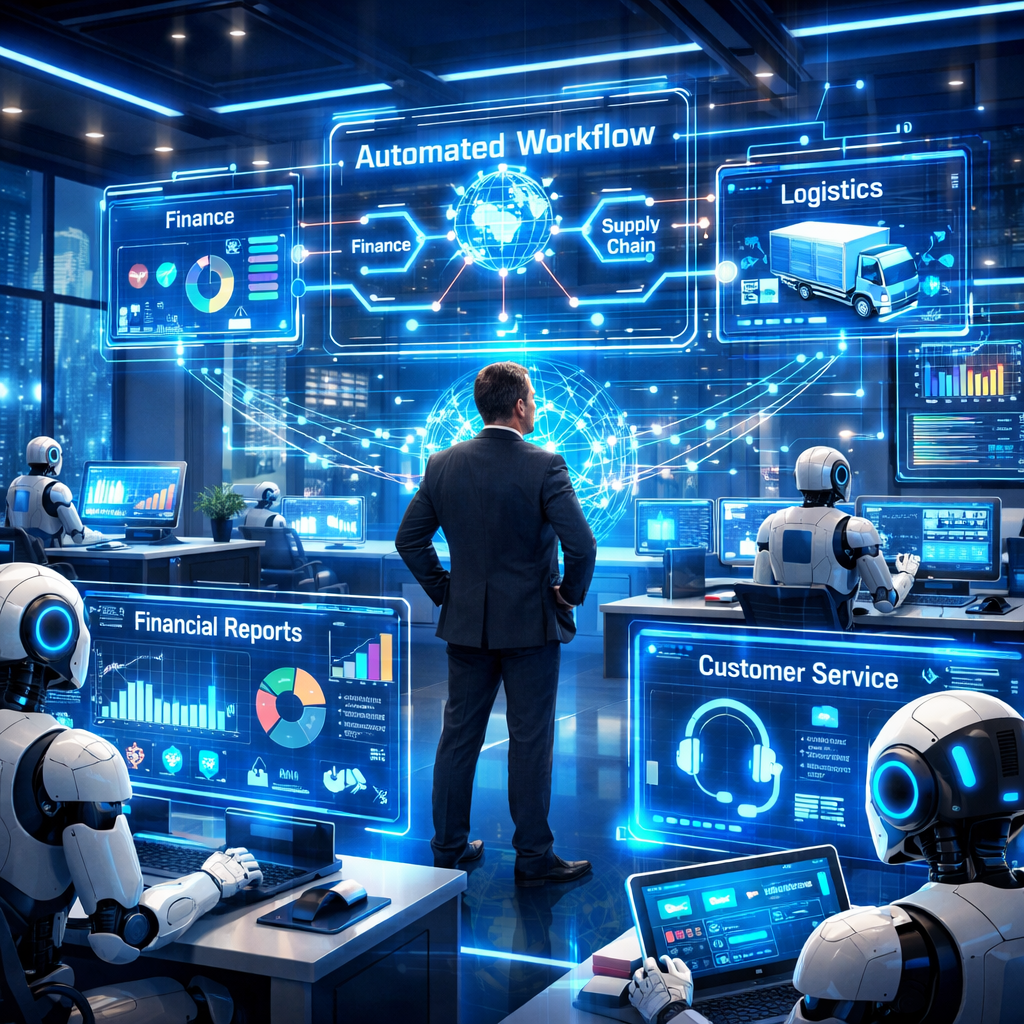
Today, artificial intelligence has stepped in to change everything. Artificial intelligence financial forecasting refers to the use of intelligent computers and software to analyze vast amounts of financial and economic data at breakneck speed and precision. These programs, which rely on techniques such as machine learning, are able to detect hidden patterns and relationships in data that the human mind may never notice.
Imagine having a smart assistant that can read millions of pages of financial reports, follow real-time global market news, analyze consumer behavior on social media, and then tell you based on all of that what to expect to happen in the future. This is exactly what AI is doing in the field of financial forecasting.
How does AI work in financial forecasting?
To understand how AI works in this area, let's simplify it down to three main steps:
Data Collecting
AI needs food to work, and its food is data. Intelligent systems collect massive amounts of data from a variety of sources. This data is not only limited to traditional financial figures such as sales and profits, but also includes other information that may seem unrelated to money, such as the weather, political events, and even tweets on the ex-Twitter platform formerly. All of this information helps the AI to form a comprehensive picture of the current situation.
Learning and analysis
This is where machine learning comes in. The AI analyzes all this data to look for recurring patterns. For example, the system may detect that sales of a particular product always rise when temperatures drop, or that a company's shares are directly affected by certain political statements. Artificial intelligence does not just memorize these patterns, but also learns from them and constantly updates its knowledge whenever it gets new data.
Predicting and making decisions
based on what it has learned from past data, AI creates complex mathematical models that predict what will happen in the future. These predictions are not just random guesses, they are probabilities based on accurate scientific and statistical foundations. Businesses can use these forecasts to make critical decisions, such as setting product prices, budgeting, or choosing the best times to invest.
Why do we need AI in financial forecasting?
The answer lies in the enormous benefits that AI offers, which often outweigh human capabilities. Here are the most important of these advantages:
-
Ultra-precise
humans make mistakes, this is an undeniable fact. A financial analyst may be affected by fatigue, emotions, or personal biases, leading to errors in expectations. Artificial intelligence, on the other hand, works only on numbers and data, and is not affected by external factors. This makes it able to provide highly accurate financial forecasts, which reduces risk and increases the chances of success. -
Incredible speed
in the world of money, time is money. Markets change in milliseconds, and quick decisions can mean the difference between profit and loss. AI is capable of processing millions of data in seconds, providing instant forecasts. This allows businesses to react quickly to changes in the market, and make proactive decisions rather than just delayed reactions. -
Detecting hidden patterns
The human mind has limits in its ability to process information. No matter how smart and experienced a financial analyst is, he can't notice every little detail in massive amounts of data. Artificial intelligence, on the other hand, is specifically designed to detect complex patterns and relationships that may seem invisible to humans. This ability opens up new avenues for discovering unexpected investment opportunities, or avoiding financial crises before they occur. -
Reduce costs
Although an initial investment in AI technologies can be costly, in the long run it saves businesses a lot of money. By automating routine and repetitive tasks, businesses can reduce the need for a large number of employees to do basic financial analysis work. This allows employees to focus on the most important tasks that require creativity and strategic thinking.
Practical Applications of Artificial Intelligence Financial Forecasting Artificial intelligence is
not just a scientific theory, it is a tangible reality that is used today in many financial fields. Here are some simple examples of how this technology can be used in our daily lives:
-
Forecasting sales and demand
Major companies use artificial intelligence to predict the future sales volume of their products. By analyzing past sales data, seasons, and even weather conditions, AI can tell a company the exact amount that needs to be produced from a particular product to meet demand without a surplus or shortage. -
Risk management and fraud detection
Banks and financial institutions use artificial intelligence to protect their customers' funds. Intelligent systems can analyze millions of financial transactions in real-time to detect any suspicious or unusual activity1 . If the system notices that your credit card is being used in another country while you are in your country, it stops the transaction immediately to protect you from fraud. -
Automated Trading in Financial Markets
In stock markets, AI algorithms are used to automatically buy and sell stocks based on accurate predictions of market movement. These algorithms are capable of analyzing economic and political news in milliseconds, making trading decisions much faster than any human trader. -
Personal financial planning
even individuals can leverage AI in managing their money. There are smart apps that analyze your spending habits, give you personalized tips on how to save money, or the best ways to invest your savings based on your future financial goals.
Challenges and concerns.
With all these incredible advantages, it's natural to wonder: Will AI take over our jobs?
The truth is that AI, while evolving, still faces some challenges. First, the quality of forecasts depends entirely on the quality of the data the system receives. If the data is inaccurate or biased, the forecast will be 1. Second, AI lacks common sense and the ability to understand the complex human context. The system may make a decision that seems mathematically correct, but it can be morally or socially disastrous.
Therefore, experts agree that AI will not completely replace humans in the financial field, but will be a powerful tool that will help them do their jobs better. The future lies in the collaboration between human intelligence and artificial intelligence. Humans will still be responsible for strategizing, setting goals, and making final decisions that require wisdom and expertise, while AI will take on complex analysis tasks and make accurate recommendations.
AI-powered high-precision financial forecasting is not just a passing technological trend, it is a real revolution that is changing the way we approach finance and business. With its ability to analyze data quickly and accurately and detect hidden patterns, AI offers powerful tools for businesses and individuals to make smarter and safer financial decisions. Despite the challenges that remain, the future looks bright. As these technologies continue to evolve, we can expect to see more innovations that will make our financial lives more stable and prosperous. Ultimately, AI is a tool, and like any tool, its true value depends on how we use it.




Add New Comment