 English
 العربية

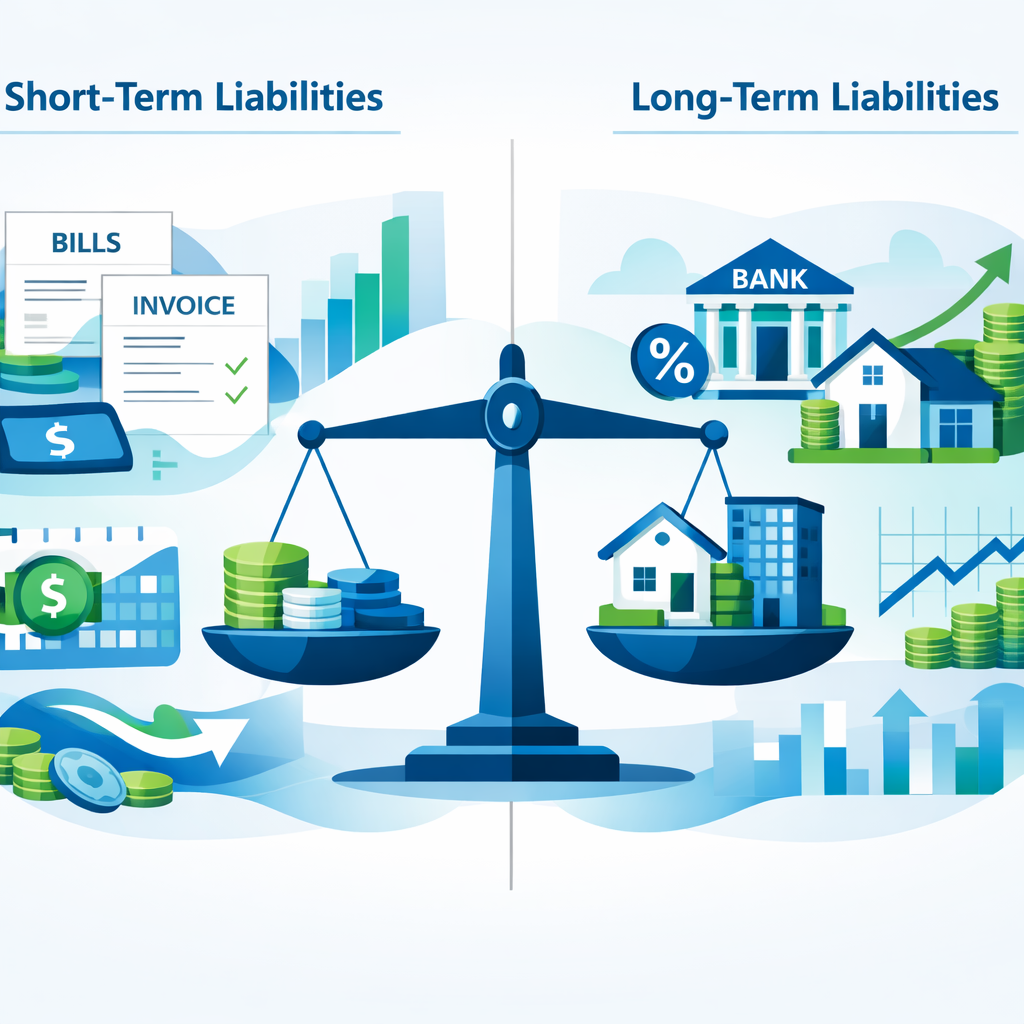
Current Liabilities and Fixed Liabilities.
In the world of finance and business, we often hear terms that may seem complicated at first glance, such as assets, liabilities, and balance sheet. However, if we strip these terms of their academic complexity, they express simple concepts that we practice in our daily lives. If assets are all the real estate, cars, and cash that the company owns, then liabilities are simply all that the company owes to others.
Understanding your opponents isn't just a task for accountants sitting behind their screens, it's an absolute necessity for every entrepreneur, entrepreneur, or even someone interested in understanding how companies are run. Successful liability management is the nexus between a company that grows and expands, and a company that is mired in debt and at risk of bankruptcy. In this article, we'll take you on a simplified journey to explain the difference between current liabilities and fixed liabilities, and how each affects the future of your business.
What are liabilities liabilities?
Quite simply, liabilities are the financial obligations that a company has towards third parties. These parties may be banks, suppliers, employees, or even the government in the form of taxes. When your company buys goods on a future, i.e., you pay for it later, or when you take out a loan to expand the factory, you create a financial discount or obligation.
Accountants view liabilities as an essential part of the balance sheet equation, which says:
assets = liabilities + equity
This means that everything the assets owned by the company were financed either by liabilities debt or by the company's equity funds. Opponents aren't necessarily a bad thing; they're fuel for growth if used wisely.
Current liabilities Short-term
liabilities are liabilities that a company must repay within a short period of time, usually one year or one operating cycle, whichever is longer. Think of them as the monthly bills and debts that are soon knocking on your door.
Why is it called Circulating?
It's called so because it's in a state of constant motion; you pay off a debt to the supplier today, take a new product for the future, and pay the employees' salaries at the end of the month. These are debts that are constantly in circulation and change in value during the year.
Common examples of current liabilities:
-
Supplier accounts payable: The amounts you owe to suppliers for goods or services that you have received and have not yet paid for.
-
Wages and salaries due: The salaries of employees for which they have worked but have not yet been paid.
-
Short-term loans: Loans that must be repaid in full in less than 12 months.
-
Taxes due: such as VAT or income tax that must be supplied to the state on specific dates soon.
-
Outstanding expenses: such as electricity, water, and internet bills that are related to the current period but have not yet been paid.
Importance of Current Liabilities:
Current liabilities are a measure of liquidity. If your current liabilities are much larger than your liquid funds and current assets, it means that you may have trouble paying your upcoming bills, which could damage your company's reputation or lead to business interruption.
Fixed or non-current liabilities Long-term debts
On the other hand, we find fixed liabilities. These obligations are not expected to be paid during the current year, but extend for long periods beyond one year.
Fixed or non-current liabilities Long-term debts
On the other hand, we find fixed liabilities. These obligations are not expected to be paid during the current year, but extend for long periods beyond one year.
Common examples of fixed liabilities:
-
Long-term bank loans: Loans that are repaid over 5 , 10 years, or more.
-
Bonds: This is a method by which large companies borrow money from the public or investors in exchange for periodic interest, and repay their value after years.
-
Deferred Tax Liabilities: Taxes due but deferred for future periods based on certain laws.
-
End of Service Benefits: These are amounts that the company is obligated to pay to its employees upon their retirement or leaving work, and it is a commitment that grows over time and is paid back in the distant future.
Importance of Fixed Liabilities:
These liabilities reflect a company's solvency and ability to plan for the future. Having well-thought-out fixed liabilities means that the company is able to gain the trust of financiers for long periods, giving it stability in funding.
What is the fundamental difference between them?
To simplify it, let's put the spreads in a clear comparison table:
First: Current Liabilities.
-
Repayment period: Less than one year.
-
Primary Objective: Financing day-to-day operations such as payroll and purchasing goods.
-
Urgency: Very high, requiring immediate liquidity.
-
Impact on liquidity: It directly affects the cash available on a daily basis.
-
Examples: Supplier invoices, salaries, taxes.
Second: Non-current fixed liabilities.
-
Repayment period: More than one year.
-
Primary Objective: Financing expansions and investments in large assets.
-
Urgency: Low , as it is repaid over long periods.
-
Impact on liquidity: It affects the long-term financing structure more than the daily liquidity.
-
Examples: Mortgages, bonds, retirement bonuses
The complementary relationship between the two types
A company cannot be satisfied with one type of adversary. The secret lies in balance.
-
Integration: Traded liabilities ensure that the wheel of action remains spinning daily, while fixed liabilities ensure that the wheel itself grows and develops.
-
Risks: Over-relying on current liabilities to fund long-term projects is a fatal mistake because it puts enormous pressure on liquidity. Imagine taking out a loan that must be repaid next month to build a factory with which to start production in two years! This is a particular financial mismanagement.
-
Trust: A company's ability to manage its regularly traded liabilities increases the confidence of banks to give them fixed liabilities and long-term loans with lower interest.
Accounting concepts that may confuse you
often non-specialists confuse liabilities with some other terms. Let's explain it simply:
-
Liabilities vs. Expenses:
-
Expense: It is a cost that a company has already consumed such as an electricity bill last month.
-
Deduction: It is the obligation to pay. If you receive your electricity bill and have not yet paid it, it is an expense in the income statement, and a deduction in the budget.
-
-
Liabilities vs. equity:
Both are a source of funding for the company, but liabilities are third-party funds that must often be returned with interest, while equity is the owners' money that is only returned when the company is liquidated or dividends are distributed. -
Liabilities vs. Assets:
Assets are what the car owns, and liabilities are what you owe the car loan.
Practical tips for managing your company's liabilities smartly
as a business owner or manager, here's how to deal with these debts:
-
Monitor the trading ratio: Always make sure that your current assets – cash, inventory, and debts to clients – cover your current liabilities at least twice. This gives you a safety zone.
-
Negotiate suppliers: Always try to extend the repayment period of current liabilities, e.g. repayment within 60 days instead of 30 without incurring interest. This provides you with free liquidity.
-
Don't fund the fixed with the trader: As mentioned, don't use funds that need to be paid back soon on long-term investments.
-
Use technology: Modern accounting software such as the Constraint system gives you alerts of payment dates and automatically classifies liabilities for you, avoiding late penalties or forgetting debts.
How does a restrictions system help you manage liabilities?
In the past, tracking debt required huge ledgers and complex spreadsheets. Today, with systems like Restrictions, it's much easier:
-
Tree of Accounts: You can accurately categorize each debt as a trader or fixed once you enter it.
-
Instant reports: With the click of a button, you can see your balance sheet and see the size of your debt and its maturity dates.
-
Supplier management: Track every riyal you owe to each supplier, and know which ones need urgent repayment.
-
Accuracy and Security: Reduce human errors that may lead to the recording of wrong debts or the forgetting of important financial obligations.
Opponents are not a monster to run away from, but a powerful financial tool if used well. Understanding the difference between what is to be paid today is current liabilities and what can be paid over years of fixed liabilities is the first step on the road to financial professionalism.
Always remember that success in trading isn't just about how much you sell, it's how you manage what you owe. Start organizing your accounts today, categorizing your liabilities, and using the technical tools available to make liabilities a way to grow your business rather than an obstacle.
If you want a hands-on experience of organizing your company's liabilities, you can start by experimenting with sophisticated accounting systems that provide you with a clear and comprehensive view of your financial situation, helping you make decisions based on accurate numbers rather than just expectations.



Add New Comment