 English
 العربية

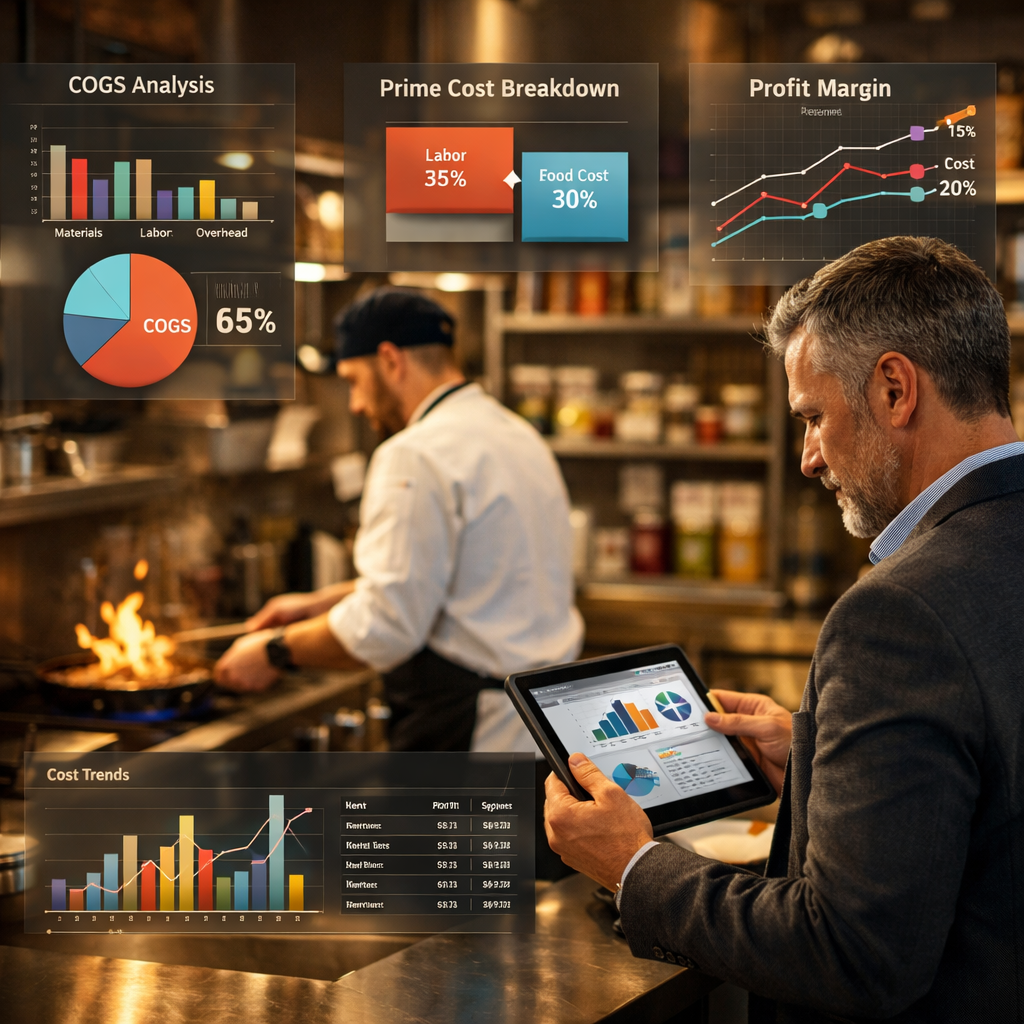
Cost accounting in restaurants.
The restaurant industry is one of the most dynamic and challenging sectors. Behind every mouthwatering meal, there are careful calculations that ensure continued profitability. That's where restaurant cost accounting comes in, the hidden engine that runs the financial helmet. In this article, we'll explain in a simple way everything you need to know about this science to develop your restaurant and ensure its sustainability.
What is Restaurant Cost Accounting Simply With?
Quite simply, restaurant cost accounting is the process of tracking every penny that comes out of a restaurant's safe and every penny that goes into it. It's not just about knowing how much you've sold today, it's about how much it cost you to make this dish, how much electricity you used, how much you paid the workers, and how much food you wasted.
Its main goal is to provide a financial "roadmap" for the restaurant owner, telling him where his money is going, where he can save, and how to set his prices in a way that attracts customers and makes him a profit at the same time.
Why should you care about cost accounting?
Some may think that accounting is just boring paperwork and schedules, but in fact it is the difference between a restaurant that closes its doors after a year and a restaurant that expands and becomes a successful brand. Here are the top reasons:
-
Make smart decisions: Instead of guessing, you'll know for sure whether a pasta dish is making a profit or if it's costing you more than you're selling.
-
Waste control: A restaurant that doesn't monitor its costs often wastes its money on damaged or excess food.
-
Setting Accurate Prices: How do you know if a price of 50 riyals per meal is the right price? Cost accounting gives you the answer based on actual numbers.
-
Planning ahead: Can you open a new branch? Can you hire an extra chef?
-
Increase profits: Sometimes, reducing costs by just 5% can double your net profit at the end of the month.
Types of costs in a restaurant:
In order to understand your restaurant's budget, you should know that costs are not one type. We can divide them into three main categories:
-
Fixed costs
are the expenses you pay whether your restaurant is full of customers or completely empty. are the costs of "continuity".
Examples: shop rent, fixed management salaries, annual license fees, and insurance.
Tip: Always try to keep these costs as low as possible at the beginning as they are a constant burden.
Impact on profit: It represents an ongoing financial burden that must be covered first before any profits are made. -
Variable costs
are expenses that increase and decrease depending on the volume of work. If you sell more, these costs will increase.
Examples: The cost of foodstuffs vegetables, meat, packaging tools, and overtime labor at peak times.
Tip: This is the area where you can get creative in saving through good management.
Impact on profit: Increases as sales increase, and can be controlled through efficiency and cost management. -
Semi-variable costs
are a combination of the two, having a fixed minimum but increasing as activity increases.
Examples: Electricity and water bills are minimal, but they increase with a lot of cooking, lighting, and maintenance expenses.
Impact on profit: Requires careful monitoring and smart management to avoid sudden spikes in expenses.
Cost of goods sold COGS.
In the restaurant world, we use a very important term called COGS. In short: "How much did the food I actually sold cost me?".
To calculate this cost accurately, we use a very simple formula:
Inventory at the beginning of the month + purchases during the month - Inventory at the end of the month = cost of goods sold
Why is this equation important?
Because you may buy goods for 10,000 riyals, but you have not used all of them. This equation tells you the true value of what came out of your kitchen and ended up on customers' tables. If this percentage is too high than usually 35%, it means that there is a problem with either prices or waste.
How to manage the cost of food professionally?
Managing the "kitchen" is the hardest and most impactful part of cost accounting. Here are practical steps to control it:
-
Smart Buying: Don't buy just to buy. Compare suppliers, and find the best quality at the most affordable price. Sometimes buying in bulk saves money, provided you have a convenient storage space.
-
FIFO "First Come, First Come" rule: This rule is golden in restaurants. Older ingredients should be used first to prevent damage. This reduces waste tremendously.
-
Waste Monitoring: Record everything that is thrown in the trash. Is it due to expiration? Or is it due to a cooking error?
-
Accurate measurement: Use scales and pints. If the chef puts "in sight," you'll find that the cost of the dish varies every time, and that's the enemy of accurate accounting.
The art of pricing meals.
Many restaurant owners set prices based on competitors only, and this is a serious mistake that can lead to bankruptcy. The correct price must go through the following steps:
-
Calculating the cost of ingredients Recipe Costing: How many grams of meat? How many tomatoes? How many spoonfuls of oil? The cost of each detail in the dish must be calculated with extreme precision. Don't even forget about salt and spices!
-
Add indirect costs: The dish doesn't just cost food, it carries a portion of the cost of labor, electricity, and rent. These costs are usually distributed as a percentage added to the cost of food.
-
Setting a Profit Target: How Much Do You Want to Make After Covering All Expenses? On average, restaurant owners aim for a net profit of 10% to 20%.
-
Perceived Value Study: After calculating the "accounting" price, ask yourself: Is the customer willing to pay this amount for this experience? Sometimes the general atmosphere of the restaurant allows you to increase the price, and sometimes vice versa.
-
Market comparison: Compare your final price to your direct competitors. If your price is much higher without a clear advantage, go back to the kitchen and look for ways to reduce the cost of ingredients instead of just lowering the price and losing profit.
Prime Cost.
In restaurant cost accounting, there is a term that combines the two most important elements: the cost of food and the cost of labor, and it is called "initial cost." Experts say that this number shouldn't exceed 60% of your total sales. If it's higher, you're in the danger zone.
Labor.
Labor is the second-largest cost in restaurants after food. Smart accounting here doesn't just mean paying salaries, it means:
-
Schedule employees smartly: Don't put 10 employees at a time when the restaurant is quiet. Use historical sales data to know peak and slump times, and deploy your team accordingly.
-
Employee turnover: Replacing an employee with a new one costs you a lot of money, advertising costs, training, and wasting time. Good accounting also includes investing in a comfortable work environment to reduce this turnover.
-
Continuous training: A trained employee makes fewer errors in orders, thus reducing waste and increasing the speed of service, which means a faster customer cycle and more profit.
-
Productivity: Does an employee get their work done in 4 hours or 8? Measuring productivity is an integral part of modern cost accounting.
Hidden costs.
There are small expenses that you may not notice, but at the end of the month they are a big amount:
-
Detergents and toiletries: their excessive consumption raises costs.
-
Delivery app commissions: These apps may take up to 30% of the order value. These commissions should be counted toward your costs when setting the price for apps.
-
Sudden maintenance: A breakdown of one refrigerator may lead to damage to goods worth thousands of riyals. Regular maintenance is an investment, not a cost.
Technology at your service
Previously, an accountant spent hours with notebooks and a calculator. Today, accounting has moved to the cloud, and software like Digital Pro has become an essential partner for a restaurant owner.
How do these tools help you?
-
Integration with a POS system: Every meal sold automatically deducts its ingredients from the inventory. This gives you a real-time view of what materials you have left.
-
Advanced Profitability Reporting: With the click of a button, you can see the "Menu Engineering Matrix," a tool that tells you which dishes are high-profit, high-sales "stars" and which are low-profit and low-sales "burdens."
-
Supplier management: Tracking invoices and due dates ensures you have a good relationship with suppliers and avoids late penalties.
-
AI alerts: Some advanced systems can predict future demand based on previous years' data, helping you buy and schedule with incredible accuracy.
The use of technology is an investment that saves thousands of riyals that would otherwise be wasted in miscalculations or mismanagement of inventory.
Golden tips to cut costs without compromising on quality
-
Negotiate your suppliers: Don't accept the first price. Your supplier wants you to be a permanent customer, so ask for discounts or additional benefits.
-
Review your Menu periodically: If a dish is not ordered, it takes up space in stock and its ingredients may be damaged. Delete it immediately.
-
Invest in your employees: A happy and appreciative employee works harder and keeps the restaurant's resources like their own.
-
Sustainability: Reducing the use of plastic and saving energy is not only good for the environment, but also saves a lot of money in the long run.
Ultimately, restaurant cost accounting isn't just a deaf number, it's your restaurant's success story told in the language of money. When you understand your costs, you have the power to control the fate of your business. Start today, if only in simple steps, and watch how these numbers translate into tangible profits and sustainable growth for your restaurant. Always remember that "what can't be measured, can't be managed," so start measuring to succeed in management.
Add New Comment