

Electronic Invoicing Software
Choosing electronic invoicing software in Saudi Arabia has become a decision that goes beyond issuing an invoice with a QR code. A business needs a system capable of creating invoices and notices electronically, processing value-added tax, storing documents, and handling the integration requirements of the “Fatoora” platform when the business enters Phase Two.
The Zakat, Tax and Customs Authority defines an electronic invoice as an invoice issued and stored in a structured electronic format through an electronic system. A handwritten or scanned invoice is not considered an electronic invoice.
Therefore, you should not look for software that merely prints the invoice layout, but for an integrated system that connects invoicing with sales, customers, inventory, payments, accounts, and reports.
You can first learn the system basics through the Electronic Invoicing in Saudi Arabia guide.
What Is Electronic Invoicing Software?
Electronic invoicing software is a technical system used to create, store, and process electronic invoices and notices according to the tax and technical requirements applicable to the business.
Its function is not limited to entering the customer’s name and the invoice value. An integrated system can manage:
- Business details and tax number.
- Customer data.
- Products and services.
- Value-added tax.
- Tax invoices.
- Simplified tax invoices.
- Credit and debit notes.
- QR codes.
- Payment methods.
- Returns.
- Invoice storage.
- Sending or sharing the customer’s copy.
- Integration with accounts and inventory.
- Integration with the Fatoora platform when Phase Two applies.
ZATCA explains that electronic invoicing includes two main types: the tax invoice, which is generally used between businesses, and the simplified tax invoice, which is generally used in transactions with the final consumer.
To distinguish between them more clearly, you can read the Tax Invoice in Saudi Arabia guide.
What Should Electronic Invoicing Software Provide?
The best way to evaluate the system is to consider the entire workflow, not the invoice design.
Issuing Tax and Simplified Invoices
The software must be able to issue the invoice type appropriate to the transaction and include the required information correctly.
Software suitable for a store that primarily serves final consumers may not have the same operational requirements as a company that provides services to other businesses.
Calculating Value-Added Tax
The system must calculate tax according to the product and service settings and display:
- The price before tax.
- The tax rate.
- The tax amount.
- Discounts.
- The final total.
However, the software cannot compensate for an error in the tax classification settings, so products and services must be configured correctly from the start.
For a broader understanding of tax handling, review the Value-Added Tax in Saudi Arabia guide.
Managing Returns and Notices
If part of an order is returned or the invoice value needs correction, the business should not rely on deleting the original invoice and manually creating a replacement.
The integrated system needs to manage:
- Credit notes.
- Debit notes.
- Full returns.
- Partial returns.
- Linking the correction to the original invoice.
Aamal Digital presents these functions as essential criteria for choosing accounting software compatible with electronic invoicing.
You can review the full list in the Choosing Accounting Software Compatible with Electronic Invoicing article.
Does Electronic Invoicing Software Need to Be Integrated with ZATCA?
Not in the same way for every business; it depends on the phase applicable to the business.
Phase One of electronic invoicing, the Generation and Storage Phase, began on December 4, 2021. Phase Two, the Integration Phase, began to be implemented gradually for groups of taxpayers on January 1, 2023.
In Phase Two, the electronic invoicing solution must integrate with the systems of the Zakat, Tax and Customs Authority, and invoices must be issued in the specified formats and according to the defined technical requirements.
The requirements that the software needs to handle during the Integration Phase include:
- Connecting the invoicing solution to the Fatoora platform.
- Onboarding invoice-generation units.
- Creating XML files according to the requirements.
- Generating a UUID.
- Applying invoice sequencing and counters.
- Generating a QR code according to the phase requirements.
- Clearing standard tax invoices.
- Reporting simplified tax invoices.
- Receiving acceptance, warning, and rejection results.
If your business receives an integration notification, you can review the Phase Two of Electronic Invoicing guide.
Must Electronic Invoicing Software Be Approved by ZATCA?
This is one of the most confusing points when choosing software.
The Zakat, Tax and Customs Authority explains that a taxpayer may obtain electronic invoicing services from any company that provides an electronic system, provided that the system used by the taxpayer complies with the electronic invoicing requirements.
The Authority also states explicitly that the published list of solution providers is for guidance only and is not binding, nor does it constitute the Authority’s approval of the technical solutions themselves.
Therefore, when comparing software, do not rely on the word “approved” alone. Ask the system provider how the actual requirements applicable to your business are implemented.
Ready to try the system?
Start your free trial or speak with the sales team to help you choose the right solution.
What Is the Difference Between Invoicing Software and Integrated Accounting Software?
Basic invoicing software primarily focuses on issuing invoices and storing their data, while integrated accounting software connects invoicing to the rest of the workflow.
| Invoicing Software Only | Integrated Accounting System |
|---|---|
| Invoice Creation | Invoice Creation |
| Customer Data | Customer Accounts |
| Tax | Tax and Reports |
| Payment Methods | Receipt and Payment Vouchers |
| Invoice Storage | Accounting Posting |
| Limited Inventory Functions | Inventory and Warehouse Management |
| Invoice Reports | Financial Statements and Reports |
When you issue a sales invoice from the integrated system, it can simultaneously update:
- The customer’s account.
- Sales revenue.
- Output tax.
- Inventory.
- The payment method.
- Reports.
- The accounting entry.
This is one reason why an integrated system is preferable for companies with inventory, points of sale, or a large number of transactions.
Ready to try the system?
Start your free trial or speak with the sales team to help you choose the right solution.
Is DigitalPro Suitable as Electronic Invoicing Software?
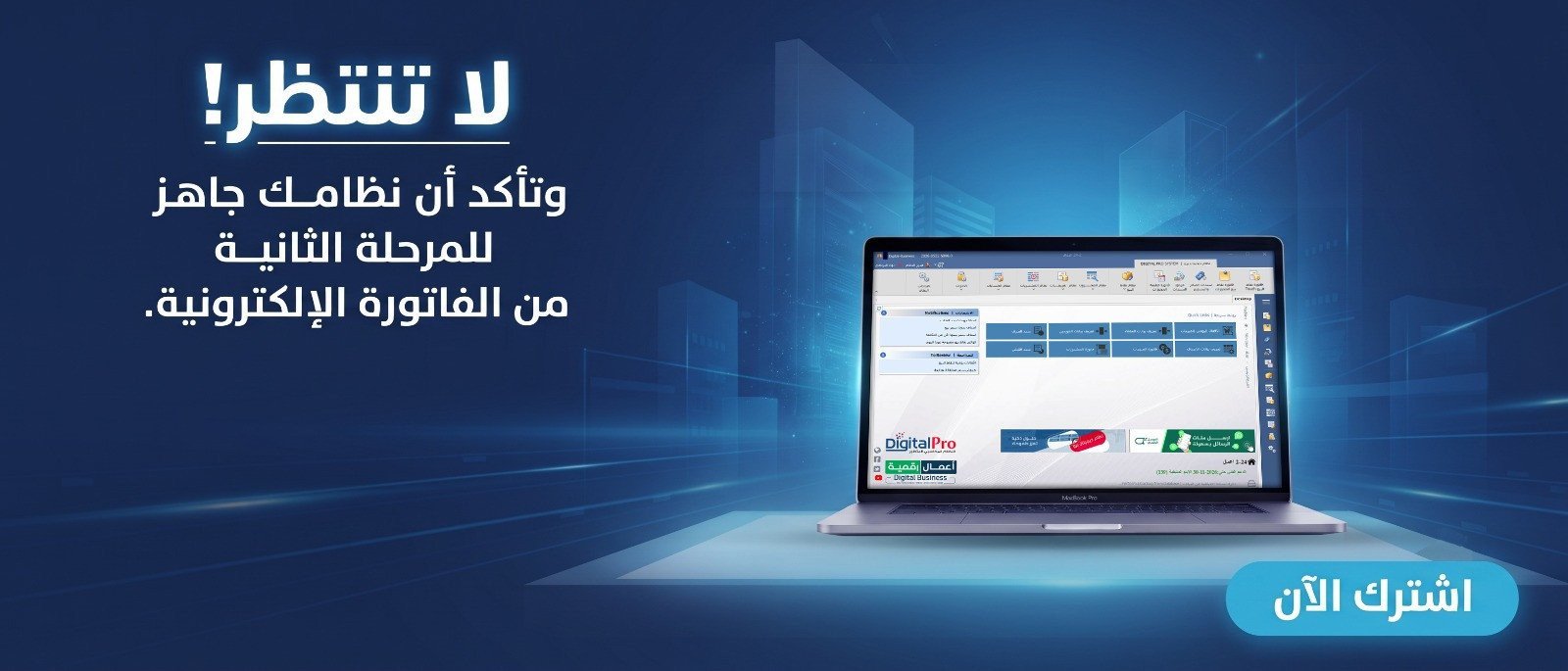
Aamal Digital presents DigitalPro as a system that combines accounting, points of sale, inventory, and reports with electronic invoicing functions, making the invoice part of the sales and accounting cycle rather than a separate document.
The system’s available functions include:
- Sales and purchases.
- Customers and suppliers.
- Inventory.
- Points of sale.
- Multiple payment methods.
- Returns.
- Financial and accounting reports.
- Sales and profit analysis.
- Product and warehouse management.
You can explore the DigitalPro Accounting and Point-of-Sale System if you want to connect invoice issuance with accounting, inventory, and points of sale instead of using separate invoicing software.
If online operation is the priority, you can also learn about DigitalPro Cloud – the cloud accounting system.
How Do You Choose the Best Electronic Invoicing Software?
Before subscribing, ask to test these operations within the system:
1. Create a Tax Invoice
Check:
- Business details.
- The customer.
- The tax number.
- Products.
- Tax.
- The total.
2. Create a Simplified Invoice
Ensure that final-consumer transactions and the applicable invoice requirements are handled correctly.
3. Process a Return
Do not test sales alone; try returning a product or adjusting an invoice value using the appropriate notice.
4. Review the Integration Status
If your business is in Phase Two, ask:
- Does the invoice acceptance status appear?
- Are warnings displayed?
- Is the reason for rejection displayed?
- How does the user resolve the error?
5. Review the Accounting Impact
After issuing the invoice, ensure that the following are updated:
- The customer’s account.
- Inventory.
- Revenue.
- Tax.
- The payment method.
- Reports.
6. Test Permissions
Not every user should be able to:
- Change prices.
- Apply a discount.
- Cancel a transaction.
- Issue a return.
- View profits.
What Are the Common Mistakes When Choosing Electronic Invoicing Software?
Avoid choosing software based solely on the invoice layout.
Common mistakes include:
- Considering a regular PDF sufficient for electronic invoicing.
- Not testing Phase Two.
- Ignoring simplified invoices.
- Not testing returns.
- Not reviewing XML and integration when Phase Two applies.
- Not knowing how to handle rejected invoices.
- Ignoring inventory and accounting.
- Not testing permissions.
- Relying on the phrase “ZATCA-approved” without understanding actual compliance.
- Choosing software that cannot scale with branches and points of sale.
ZATCA’s requirements confirm that an electronic invoice must be issued through an electronic system and in a structured format, and that the Integration Phase adds technical requirements that go beyond the invoice’s visual appearance.
Frequently Asked Questions About Electronic Invoicing Software
What Is the Best Electronic Invoicing Software?
The best software is the system that suits the nature of your business, issues the required invoice types, supports value-added tax, returns, and notices, and meets the integration requirements when the business is subject to Phase Two.
Is Electronic Invoicing Software Mandatory?
Persons subject to the Electronic Invoicing Regulation must issue and store invoices through an electronic solution according to the phase applicable to them. The Generation and Storage Phase began on December 4, 2021, while the Integration Phase is being implemented gradually for the targeted groups.
Is Excel Considered Electronic Invoicing Software?
Manually creating an invoice in document-editing tools or relying on an image or scanned copy is not sufficient. It must be issued and stored through an electronic system in a manner that complies with the applicable requirements.
Does the Software Need a QR Code?
The details depend on the invoice type and the applicable phase, but the QR code is an important element of the simplified tax invoice, and Phase Two includes additional technical requirements related to it.
Does Electronic Invoicing Software Require an Internet Connection?
The operating mechanism during a connection outage may vary depending on the system, invoice type, and phase. Therefore, you should ask the software provider specifically how invoices are issued, stored, and resent when the connection is restored.
What Is the Difference Between an Electronic Invoice and a Tax Invoice?
A tax invoice describes the invoice type and its tax content, while “electronic” describes how it is issued, stored, and processed. Therefore, a tax invoice can be an electronic invoice when it is issued through the electronic system according to the requirements.
How Do I Integrate Electronic Invoicing Software with ZATCA?
If your business is targeted for Phase Two, the invoice-generation units are onboarded and the electronic solution is connected to the Fatoora platform according to the Authority’s procedures and technical requirements. You can review the How to Register for Electronic Invoicing guide for detailed steps.
Conclusion
Choosing the right electronic invoicing software does not begin with the invoice design, but with the workflow you want to manage.
The right software should help you issue tax and simplified invoices, calculate tax, manage returns and notices, store data, and implement the integration requirements of the Fatoora platform when your business is included in Phase Two.
If your business has sales, inventory, customers, and points of sale, it is better for invoicing to be part of an integrated accounting system rather than operating separate invoicing software and then manually transferring the data to the accounts.
Aamal Digital provides DigitalPro for Accounting and Point of Sale to connect invoicing with sales, inventory, payments, and reports within one system, alongside cloud solutions and specialized systems for various activities.
You can explore Aamal Digital solutions, then request a free trial and test a sales invoice, a return, a simplified invoice, and the reports before choosing the final system.
Start Managing Your Business with Complete Flexibility
Try Aamal Digital for free. Start issuing ZATCA-compliant electronic invoices within minutes.
- Free trial with no credit card required
- 24-hour technical support
- ZATCA-compliant