
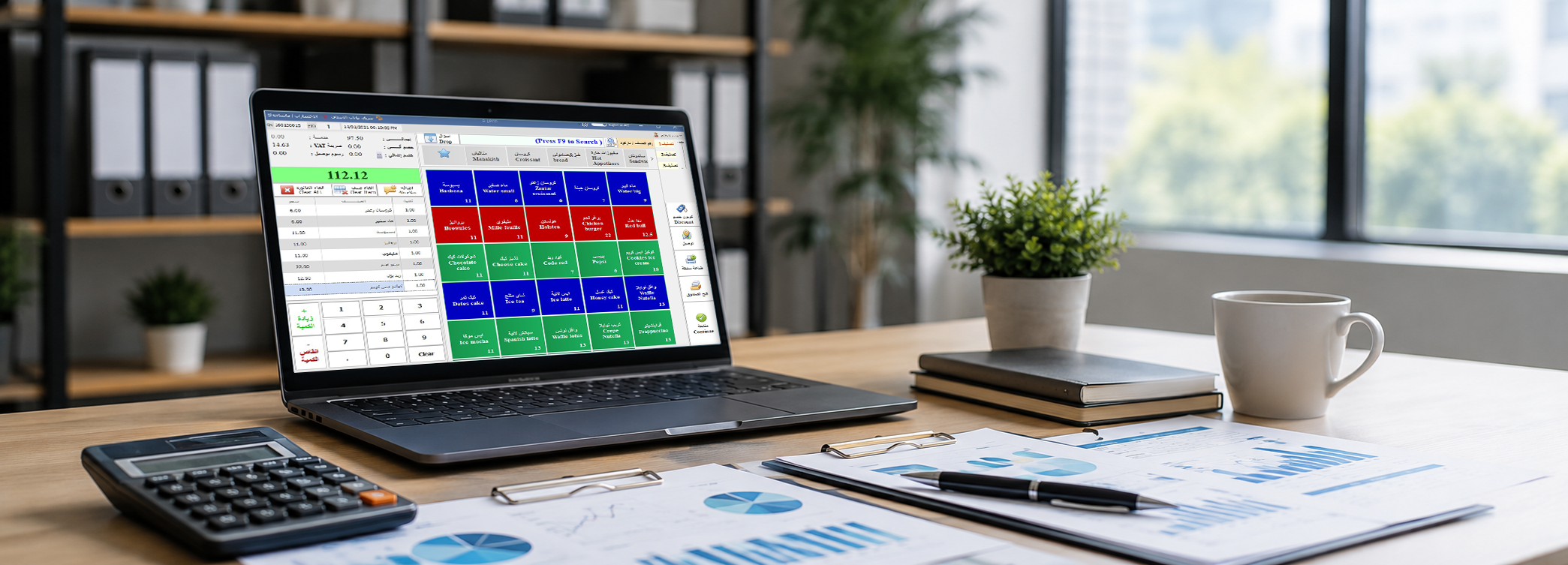
Your Comprehensive Guide to Choosing the Best Accounting Software Compatible with E-Invoicing
Choosing an accounting software compatible with e-invoicing is no longer just a technical decision for the accountant alone; rather, it has become a decision that impacts sales, inventory, taxes, branches, reports, and business continuity. An unsuitable software might issue an invoice that looks correct to the customer, but fails to meet the required data, electronic format, or properly handle returns, credit notes, and debit notes in an organized manner.
It is not enough for the software to merely print an invoice or generate a PDF file. An organization needs an integrated system that connects the invoice to the sales process, customer account, VAT, inventory movement, payment method, accounting entry, and then executes the integration requirements with the "Fatoora" platform when entering Phase 2.
This guide explains the concept and types of accounting software, e-invoicing and its types, the importance of using an integrated accounting system, and how DigitalPro can help Saudi businesses organize accounting and e-invoicing within an interconnected operating environment.
What Are Accounting Systems/Software?
Accounting software are digital systems used to record, process, store, and report financial transactions, instead of relying primarily on paper ledgers or separate Excel files.
The role of accounting software begins from the moment a document is recorded, such as a sales or purchase invoice, and extends to analyzing the impact of the transaction, posting it to the appropriate accounts, and reflecting it in reports.
Among the most important functions of accounting software:
- Creating the chart of accounts.
- Recording journal entries.
- Managing sales and purchases.
- Issuing invoices and notices/memos.
- Tracking customer and vendor accounts.
- Recording receipt and payment vouchers.
- Managing expenses and revenues.
- Tracking inventory and warehouses.
- Calculating Value Added Tax (VAT).
- Managing branches and cost centers.
- Performing bank reconciliations.
- Generating the trial balance.
- Preparing income statements and balance sheets.
- Preparing cash flow reports.
- Managing users and permissions.
- Archiving documents and transaction logs.
Not every software that issues an invoice is a fully integrated accounting software. A simple application might focus on entering customer names and products to print an invoice, without providing journal entries, general ledger, inventory, cost centers, or financial reports.
When issuing a sales invoice from a standalone invoicing app, the accountant may have to re-enter the transaction into the accounting software. However, when using an integrated accounting system, invoice data can flow seamlessly into sales, tax, customer account, inventory, and reports in a single workflow cycle.
The basic infrastructure of an accounting software consists of:
- A database for transactions.
- A chart of accounts.
- Modules for sales and purchases.
- Modules for customers and vendors.
- An engine for taxes and entries.
- User permissions.
- Financial and operational reports.
- Tools for data archiving and backups.
- Integrations with other systems.
Accuracy of data must be ensured and entries must be clear, as the system cannot prevent all errors resulting from selecting an inappropriate account, entering an incorrect tax number, or misclassifying a product under a wrong tax category.
Types of Accounting Software
Types of accounting software vary based on deployment method, company size, business nature, and required functionalities. There is no single type that fits all businesses.
| Software Type | Key Features | Suitable Use Case |
|---|---|---|
| Invoicing Software | Creating invoices and tracking collections | Businesses with limited transactions |
| Desktop Accounting Software | Entries, accounts, and reporting | Businesses operating from a single location |
| Cloud Accounting Software | Managing accounts online | Multi-branch or remote businesses |
| Accounting & Inventory Software | Sales, purchases, and inventory management | Retail stores and distribution companies |
| Accounting & Point of Sale (POS) | Cashier, inventory, and ledger accounts | Shops and supermarkets |
| Industry-Specific Software | Tailored functions for specific sectors | Restaurants, hotels, and contracting |
| ERP System | Integrating enterprise departments | Medium and large enterprises |
Invoicing Software
Focuses on generating invoices, quotations, and tracking payments. It might be suitable for early-stage small service businesses, but falls short when comprehensive accounting, inventory, or branch management is required.
Desktop Accounting Software
Installed locally on a PC or on-premise server, usually operating via a local network. Suitable when internet connection is limited, but requires manual handling of updates, backups, and multi-branch connections.
Cloud Accounting Software
Operates via the internet, enabling authorized users to access financial records from various devices and locations. Small and medium enterprises can review cloud accounting system features supporting core accounting, e-invoicing, and financial reporting.
The DigitalPro Cloud page highlights that it is a cloud accounting system designed for SMEs, supporting Arabic language, archiving, e-invoicing, and reporting, with full readiness for Phase 2 compliance.
Accounting and Inventory Software
Links sales and purchase invoices directly to quantities, costs, and warehouse stock. Ideal for businesses needing real-time visibility of stock levels, transfers, physical counts, damages, and slow-moving items.
Point of Sale (POS) Software
Used inside retail outlets, restaurants, and branches to register sales, process payments, and print invoices. Must seamlessly connect to inventory and accounts to prevent discrepancies between cashier logs and financial reports.
Industry-Specific Software
Includes features not commonly found in generic software. For instance, a restaurant requires table management, kitchen order tokens (KOT), recipes, delivery tracking, and meal cost analysis, benefiting from an accounting system tailored for restaurants and cafes that connects orders, stock, invoicing, and accounting.
The DigitalPro Restaurant page details features for POS, order management, inventory, and reporting, alongside automated journal entries, VAT compliance, and integration readiness with the Fatoora platform.
Enterprise Resource Planning (ERP) Systems
Interconnects accounting with sales, procurement, inventory, projects, and other operational departments. Suitable for organizations seeking a single unified database rather than running disparate systems that do not share information.
When comparing options, the question shouldn't be: Which software has the highest number of features? But rather: Which system covers my business workflow smoothly without unnecessary complexity, and scales alongside my business as branches, users, and transaction volumes grow?
What is E-Invoicing?
An e-invoice is an invoice issued, received, and stored in a structured electronic format via an electronic system, containing all required tax invoice elements. Handwritten, scanned, or word-processor generated invoices do not meet the legal requirements of an e-invoicing framework.
The goal of the e-invoicing ecosystem is to transition from paper invoices and notes to an electronic system that allows seamless generation, exchange, and processing in a structured format between buyer and seller.
An e-invoice encompasses several interconnected components:
- Supplier details.
- Buyer details (where applicable).
- Invoice type.
- Issue date and timestamp.
- Sequential invoice number.
- Itemized goods or services description.
- Quantities, prices, and discounts.
- Value Added Tax (VAT).
- Grand total amount.
- Quick Response (QR) code where applicable.
- Required technical and security parameters.
- XML file structure in Phase 2.
- Reference to original invoices when issuing credit/debit notes.
E-invoicing implementation in Saudi Arabia was divided into two main phases:
Phase 1: Generation & Archiving
Enforced on December 4, 2021, focusing on issuing and storing invoices and notes electronically through a compliant technical solution.
Phase 2: Integration & Connectivity
Rolled out in waves starting January 1, 2023, requiring integration between the taxpayer's invoicing software and the "Fatoora" platform, producing documents in specified electronic schemas. The Zakat, Tax and Customs Authority (ZATCA) notifies targeted taxpayers at least six months prior to their mandatory integration date.
Therefore, an accounting software must fulfill two distinct objectives:
- Managing the invoice from a commercial and accounting standpoint.
- Executing technical requirements for e-invoicing compliance.
A document might display customer details and tax values, yet remain non-compliant if it isn't generated and archived in the mandatory format or if the generation module isn't properly onboarded and integrated upon reaching Phase 2.
Additionally, note that the published list of solution providers by the authority is indicative and non-binding, nor does it guarantee universal approval of every program version. Taxpayers are free to use any technical solution as long as the deployed system complies with the requirements.
Read also: What is E-Invoicing?
Types of E-Invoices
E-invoices in Saudi Arabia are mainly categorized into Standard Tax Invoices and Simplified Tax Invoices, alongside Credit and Debit Notes used to adjust the original invoice impact.
| Document Type | Common Use Case | Phase 2 Workflow |
|---|---|---|
| Standard Tax Invoice | Business-to-Business (B2B) transactions | Clearance before sharing with buyer |
| Simplified Tax Invoice | Business-to-Consumer (B2C) sales | Reporting within the specified timeframe |
| Credit Note | Reducing value of a prior invoice | Linked to the original invoice |
| Debit Note | Increasing value of a prior invoice | Linked to the original invoice |
Ready to test the system?
Start your free trial or talk to our sales team to help you choose the right solution.
Standard Tax Invoice
Primarily used in B2B transactions between enterprises, carrying detailed disclosures about seller, buyer, supply details, and VAT amounts.
Key elements include:
- Supplier name and address.
- Supplier Tax Identification Number (TIN).
- Required buyer details.
- Buyer TIN (where applicable).
- Invoice number and date.
- Description of goods or services.
- Quantities and unit prices.
- Discounts.
- Taxable amount.
- VAT rate and amount.
- Grand total.
In Phase 2, Standard Tax Invoices must be submitted to the Fatoora portal for validation and clearance before issuing the final version to the buyer.
Simplified Tax Invoice
Mostly issued during direct B2C point-of-sale transactions, such as retail, restaurant, and cafe sales.
Key elements usually include:
- Seller details.
- Tax Identification Number (TIN).
- Issue date and timestamp.
- Sequential number.
- Item breakdown.
- VAT amount.
- Grand total.
- QR Code.
In Phase 2, Simplified Invoices must be reported to the Fatoora portal within the mandated timeframe and technical rules.
Credit Note
Issued to decrease the total value of a previously issued invoice, such as in cases of:
- Product returns.
- Partial order cancellations.
- Post-sale discounts.
- Correcting overcharged values.
Debit Note
Issued to increase the payable amount on a previous invoice, such as:
- Adding unbilled services.
- Correcting undercharged values.
- Adding extra surcharges or fees associated with the supply.
Original invoices must never be edited or deleted after issuance to handle returns. Instead, a linked credit/debit note must be generated, recording the exact reason for modification while preserving proper financial, stock, and tax ledger entries.
Importance of Choosing an E-Invoicing Compliant Accounting Software
The core importance of choosing an e-invoicing compliant accounting software lies in the system becoming responsible for handling interconnected financial, tax, and technical data, rather than merely printing invoice templates.
Key benefits of a proper accounting system include:
Issuing Invoices with Required Mandated Data
Helps populate company credentials, VAT number, issuance/supply dates, itemized breakdowns, taxes, and totals in a structured layout.
Minimizing Manual Calculation Errors
Automatically calculates VAT, discounts, and total values based on item settings, reducing human errors—provided that tax categories are correctly configured.
Connecting Invoices to General Accounting
Upon invoice issuance, revenue, output tax, customer ledger, payment method, and journal entries are posted automatically.
Real-Time Inventory Updates
Deducts sold quantities, reverses stock on returns, updates item cost averages, and generates real-time inventory flow reports.
Managing Branches and POS Terminals
Multi-branch businesses can onboard and manage all invoice issuance units, sequential numbers, and statuses from a central control panel.
Handling Rejected Invoices
Displays transmission status (success, cleared, warning, rejected), explaining technical error reasons and resolution paths.
Maintaining Audit Trails
Logs user actions (who created or approved transactions, with exact timestamps) and blocks unauthorized alterations or deletions.
Providing Tax Reports
Facilitates audit and review of sales, returns, output tax, and input tax prior to filing VAT returns.
Supporting Business Growth
Allows adding users, branches, warehouses, and POS terminals without needing to replace the entire software infrastructure.
When selecting a software, verify the presence of the following capabilities:
- Standard and Simplified Tax Invoice support.
- VAT calculation engine.
- XML generation.
- Compliant QR Code generation.
- Integration capability with the Fatoora platform.
- Clearance and reporting management.
- Credit and Debit Notes generation.
- Sequential invoice numbering structure.
- User access and permission management.
- Invoice archiving and backup routines.
- Branch and unit management.
- Sales-to-inventory linking.
- Automatic entries and financial reporting.
- Offline transaction buffering.
- Continuous technical support and software updates.
- Data export functionality.
How DigitalPro Accounting System Integrates with E-Invoicing
DigitalPro seamlessly integrates with e-invoicing by unifying invoice creation with sales, inventory, payments, accounts, and reporting in one platform.
The DigitalPro platform brings together accounting, POS, and management features with full e-invoicing support and Phase 2 ZATCA integration readiness.
The integrated workflow operates as follows:
- User selects or adds customer details.
- Adds products or services to the bill.
- System fetches configured prices and tax rates.
- Applies permitted discounts based on role rights.
- Calculates subtotal and VAT.
- Registers payment method.
- Issues the compliant e-invoice.
- Updates customer balance statement.
- Deducts item stock counts.
- Reflects the transaction in reports.
- Generates double-entry accounting records automatically.
Key features of DigitalPro accounting and POS system include:
- Customizable user interfaces.
- Compatibility with various POS hardware and devices.
- Multiple payment method options.
- Invoicing with instant save, print, and share options.
- Returns and adjustments management.
- Financial and accounting reporting.
- Sales and profitability analytics.
- Inventory and product movement tracking.
- Interactive dashboards.
- Vendor and warehouse management.
- Multi-unit and multi-barcode support per item. Tav
This workflow solves a very common problem: discrepancies between cashier terminal totals and accounting ledger records. In an integrated architecture, the invoice serves as the single source of truth for financial and inventory entries, eliminating manual end-of-day postings.
Smart reporting tools can be utilized to monitor invoices, sales performance, returns, stock levels, and vendor/customer ledgers from live system data.
Multi-location businesses can utilize cloud deployment options to access accounts, invoices, and reports securely based on user permissions, complete with offline mode support for internet interruptions.
Before launching DigitalPro, the following setup steps should be completed:
Ready to test the system?
Start your free trial or talk to our sales team to help you choose the right solution.
- Review company details and VAT registration number.
- Configure branches and invoice generation units (EUDs).
- Organize the chart of accounts.
- Set up tax rates and product categories.
- Review customer and supplier master records.
- Input products, units, and barcodes.
- Define employee roles and user permissions.
- Enter opening balances.
- Configure ZATCA integration based on the company's rollout phase.
- Test invoice and credit note issuance.
- Reconcile reports before going live.
Advantages of Using Aamalsoft Software Solutions
Aamalsoft offers a wide array of software solutions covering accounting, POS, e-invoicing, cloud systems, and specialized industry applications, allowing businesses to select the platform closest to their operational workflow.
You can explore Aamalsoft solutions to discover accounting and POS systems, cloud editions, restaurant software, hotel management, CRM, and analytics modules.
Practical benefits include:
Unified Accounting and Point of Sale
Unifying POS and accounting logs sales, payments, returns, and inventory directly into a central database, eliminating isolated standalone systems per branch.
Cloud Solutions
Cloud systems allow real-time monitoring across devices and sites, ideal for multi-branch operations or remote accounting setups.
Industry-Tailored Systems
Not all businesses operate the same way. Aamalsoft provides specialized software for restaurants, cafes, hotels, and other verticals, avoiding a "one-size-fits-all" approach.
Advanced Inventory Management
Comprehensive inventory tools to track stock levels, landed costs, vendors, warehouses, and returns, with full support for barcodes, multi-units, and expiry dates.
Financial and Operational Analytics
Deep reporting capabilities help evaluate sales, profitability, product velocity, stock health, and accounts receivables/payables beyond cash-in-hand figures.
ZATCA E-Invoicing Compliance
Systems are designed for ZATCA compliance and Phase 2 integration readiness, while the business retains responsibility for proper setup, correct data input, and testing onboarded units.
Scalability
Start with a core accounting and POS package, then expand to cloud or specialized vertical modules as user count, branch network, and transactional volume scale up.
No system is universally "best" without testing against specific operational requirements. Therefore, a live software demo should evaluate realistic daily scenarios, such as:
- Issuing a simplified consumer receipt.
- Issuing a standard B2B tax invoice.
- Processing partial payments.
- Handling customer returns.
- Generating a credit note.
- Closing a cashier shift.
- Performing stock level checks.
- Generating a customer account statement.
- Exporting sales and tax summaries.
- Testing cross-branch synchronization.
Discover products and services, then book a live demo to test DigitalPro on your actual business workflows. You can request a free trial version or contact our team to detail your branch count, POS terminals, invoice types, and reporting needs.
Ready to test the system?
Start your free trial or talk to our sales team to help you choose the right solution.
Frequently Asked Questions
What is the best software for generating e-invoices?
The best software is one that supports your specific invoice types, complies with e-invoicing regulatory guidelines, and seamlessly links invoices with accounting ledgers, inventory, and VAT reporting.
It should provide:
- Standard and Simplified Tax Invoices.
- XML and compliant QR Code generation.
- Credit and Debit Notes management.
- Branch and unit management.
- Tax compliance reports.
- Role permission control and audit logs.
- Software updates and technical support.
DigitalPro can be evaluated through a hands-on trial covering invoice generation, returns, and real-time ledger/inventory postings.
What is the best app for managing e-invoices?
The best e-invoicing management app goes beyond creating an invoice layout—it manages the complete transaction lifecycle from quotations to collections, returns, and reports.
It should ideally support:
- Customer and product directories.
- Price lists and discount rules.
- Multiple payment methods.
- Credit sales and receivables.
- Payment collections.
- E-invoicing compliance.
- Business analytics.
- Automated backups.
- Cross-device access (mobile and desktop).
- Accounting integration.
What are the top e-accounting applications?
Top applications vary by industry focus. A service company requires invoicing, customer accounts, and expense tracking; a retail store needs POS and inventory control; a restaurant requires table management and kitchen order routines.
When comparing apps, evaluate:
- Ease of use.
- Core accounting functionality.
- E-invoicing integration.
- Tax management.
- Inventory controls.
- Multi-branch support.
- Reporting depth.
- Role security.
- Data protection.
- Integrations.
- Total cost of ownership.
- Trial availability.
What are e-invoicing codes?
E-invoicing codes are standardized identifiers, tags, and technical metadata that identify, validate, and electronically process invoices.
They include:
- Sequential invoice serial number.
- Universally Unique Identifier (UUID).
- Invoice type code.
- Tax Identification Number (TIN).
- Currency code.
- Unit and tax category codes.
- QR Code data string.
- Invoice cryptographic hash.
- Cryptographic stamp data.
- Original invoice reference code for credit/debit notes.
Users should not create these technical codes manually; the e-invoicing system must generate them automatically following technical specifications.
What is the E-Invoicing Portal (Fatoora Portal)?
The E-Invoicing Portal is ZATCA's "Fatoora" platform, used during Phase 2 integration routines.
Through the portal, taxpayers complete device onboarding (EUD setup), obtain cryptographic tokens, and manage integration settings, while the accounting software handles sending, clearing, or reporting invoices automatically via APIs.
The portal does not replace accounting software; enterprises still require compliant software to generate, store, and process daily financial transactions.
What is the first step in starting e-invoicing?
The first step is verifying your tax registration status and the mandatory e-invoicing phase applicable to your business, followed by selecting a compliant software solution and setting up accurate company master data.
Subsequent steps include:
- Configuring TIN and address details.
- Defining branches and issuance units.
- Importing customer and product catalogs.
- Setting tax rates and categories.
- Defining invoice types (Standard / Simplified).
- Testing the system before full go-live.
What are the procedures for issuing an e-invoice?
Standard steps to issue an e-invoice include:
- Log in to the invoicing system.
- Select invoice type.
- Choose customer account.
- Add goods or services.
- Enter quantities and prices.
- Apply discounts (if applicable).
- Verify VAT calculation.
- Select payment method.
- Review invoice summary and totals.
- Generate the invoice in the system.
- Perform clearance or reporting (Phase 2 API call).
- Share human-readable copy with the customer.
- Archive invoice XML and response logs.
- Post financial, tax, and inventory entries.
Conclusion: Choosing an e-invoicing compliant accounting software helps organizations manage invoices as part of a complete financial ecosystem rather than an isolated document. The right software connects sales with tax, customer ledgers, inventory, payment channels, and financial analytics, while guaranteeing technical compliance with regulatory requirements.
Start Managing Your Business with Complete Flexibility
Try Aamalsoft for free. Start issuing ZATCA-compliant e-invoices within minutes.
- Free trial without credit card
- 24/7 Technical Support
- ZATCA Compliant