
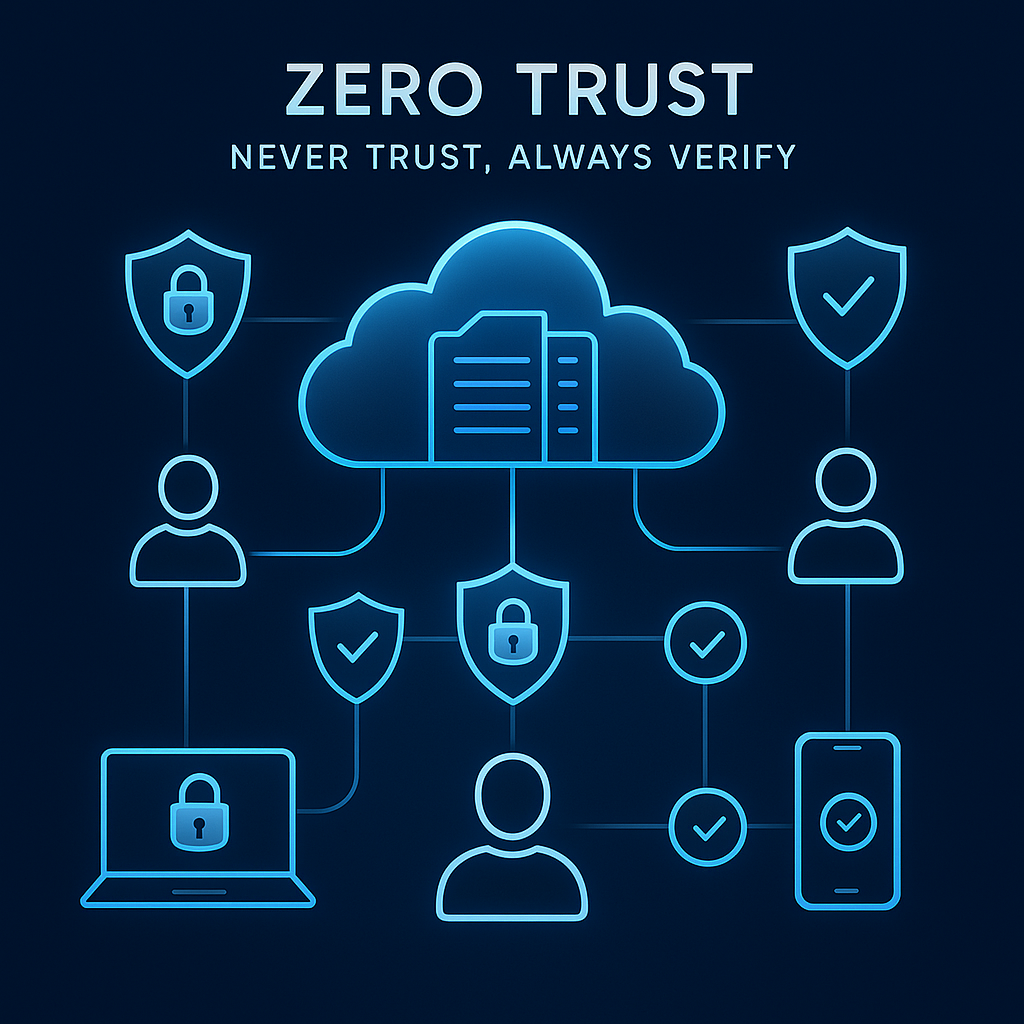
Zero Trust Model Why has it become a necessity to protect your data in the cloud age?
In today's world, where digital transformation is accelerating and technology is becoming increasingly reliant, data has become the new oil. Every day, we create, store, and share vast amounts of information, whether personal or business, over the Internet and cloud services. This enormous development, while enormous benefits, has brought with it unprecedented security challenges. As cyberattacks grow in number and complexity, the most important question has become: How do we protect our data in this vast digital space?
Traditional security models have long relied on the concept of tacit trust. The prevailing assumption was that everything that falls within the boundaries of an organization's network such as firewalls is safe and reliable, while anything outside these boundaries is considered unreliable. This concept, which resembles a fortress protecting its inhabitants from external enemies, has been effective in the past when IT infrastructure was centralized and limited. But with the advent of cloud computing, remote work, and the use of mobile devices, these traditional boundaries are fading. There is no longer a well-defined fortress, but we live in a limitless world, where data can be accessed from anywhere, at any time.
This radical change in the security landscape has shown the inadequacy of traditional models. Once an attacker is able to break through the network's outer wall, they have freedom of movement within it, taking advantage of the implicit trust given to users and internal devices. Here, the Zero Trust model emerges as a new security philosophy, which never relies on trust, but always checks everything. It's a radical shift in the way we think about cybersecurity, and it's an urgent necessity to protect our data in the cloud age.
What is the Zero Trust model?
In essence, the Zero Trust model can be summed up in a simple and powerful statement: Never trust, always verify. This means that no user, device, or app should be automatically trusted, regardless of their location, whether it's inside or outside the traditional network. Instead, every attempt to access resources should be strictly checked, as if they were coming from an untrusted source.
This model is based on three basic principles:
-
Continuous Verification
is not enough to verify the identity of the user or device once when you sign in. Rather, every resource access request must be verified on an ongoing basis. This means that the security system re-evaluates trust every time a user or device tries to access a new resource, or even when access to the same resource continues. This ensures that any change in trust status such as the detection of a compromised device will result in access being withdrawn immediately. -
Least Privilege Users
and devices should be given only the minimum permissions necessary to perform their tasks, and for the shortest possible period of time. Instead of granting broad access, the permissions are defined with extreme precision. For example, if an employee needs to access a specific file, they only get access to that file, not to an entire folder or entire server. This reduces the potential attack area if an account is compromised. -
Assume Breach The
Zero Trust model assumes that the breach has already occurred or will inevitably occur. This proactive thinking drives organizations to design their security systems based on this assumption, rather than focusing solely on preventing intrusions. This means always being prepared to detect and react to threats quickly, and minimizing potential damage in the event of a breach.
To understand the difference between Zero Trust and traditional models, imagine a castle surrounded by a moat. In the traditional model, once you cross the ditch and enter the castle, you are assumed to be reliable and can roam freely. In the Zero Trust model, even if you're inside the castle, you'll be asked to show your identity and check your powers every time you try to enter a new room or access a specific treasure. This shift from tacit trust to never-distrust is at the core of Zero Trust's philosophy.
Why has Zero Trust become a necessity in the cloud age?
Cybersecurity is no longer just a technical issue, but has become a strategic challenge facing every organization and individual. With the rapid developments in the digital landscape, the Zero Trust model has become an urgent necessity, especially in the cloud age, for several main reasons:
-
The proliferation of cloud computing and remote work: Businesses are increasingly relying on cloud services to store data and run applications, and remote work is becoming the norm rather than the exception. This means that employees access company resources from different locations and devices, often outside of the organization's traditional security control. In this scenario, traditional network boundaries cannot be relied upon for protection, and each access request must be verified regardless of its source.
-
Traditional network boundaries have faded: In the past, an organization's internal network was considered a safe and reliable area. But with the use of cloud services, SaaS applications as a service, and mobile devices, there are no longer clear boundaries for the network. Data and resources have become distributed across multiple environments, rendering the concept of a castle and a moat inefficient. Zero Trust addresses this issue by applying strict security policies to every access point, no matter where it is located.
-
Increasing and sophisticated cyberattacks: Cyberattack methods are constantly evolving, becoming more sophisticated and sophisticated. Attackers are no longer just targeting external intrusion, but also seeking lateral movement within networks once inside. The Zero Trust model, by assuming continuous penetration and applying the principle of least privileges, significantly limits the ability of attackers to move within the network and minimize potential damage.
-
Protect sensitive data in multiple environments: Organizations often have sensitive and critical data distributed across on-premises servers, public and private cloud services, and third-party applications. Protecting this data in hybrid and complex environments requires a unified and comprehensive security approach. Zero Trust provides this approach by implementing consistent access policies across all environments, ensuring data is protected wherever it is.
-
Compliance with security regulations and standards: Many security regulations and standards such as GDPR, HIPAA, PCI DSS impose strict requirements for data protection and access control. Applying the Zero Trust principles helps organizations meet these requirements, by providing robust mechanisms for identity verification, enforcing access policies, and monitoring activities, which enhances compliance and reduces legal and financial risks.
Benefits of Zero Trust for Non-Professionals and Entrepreneurs The
concept of Zero Trust may seem complicated at first glance, especially for non-specialists and entrepreneurs who are focused on growing their business. But in reality, this model offers practical and tangible benefits that can make a big difference in protecting their digital assets:
-
Simplifying cybersecurity: Contrary to what some might think, Zero Trust doesn't increase complexity, it simplifies security in the long run. Instead of managing multiple firewalls, VPNs, and complex access rules, Zero Trust provides a unified approach to access control based on identity and context. This reduces human errors and makes it easier to manage security policies.
-
Reduce the risk of hacking and data leakage: Through continuous verification and application of the principle of least privileges, Zero Trust significantly reduces the chances of successful cyberattacks. Even if an attacker manages to penetrate a single entry point, their ability to move within the network and access sensitive data will be very limited, reducing the size of the potential damage.
-
Compliance with security regulations and standards: With the rise of data protection regulations such as the GDPR, compliance has become a legal and business imperative. Zero Trust helps businesses meet these requirements by providing detailed audit logs and precise access control, making it easier to demonstrate compliance and avoid hefty fines.
-
Build trust with customers and partners: In an era where data breaches are making headlines, customers and partners are increasingly paying attention to the security of their data. Adopting a Zero Trust model sends a clear message that your company takes security seriously, which boosts trust and improves brand reputation.
-
Flexibility and adaptability: Zero Trust provides high flexibility for organizations to operate in diverse environments, whether they are fully cloud, hybrid, or even traditional. It also makes it easier to integrate new technologies and deal with changes in business requirements, such as rapid expansion or shift to remote work, without compromising security.
How do I get started with Zero Trust?
Zero Trust can seem like a daunting task, especially for small and medium-sized enterprises. But the truth is that you can start with simple and gradual steps, without the need for a radical change in the infrastructure all at once. Here are some simple practical steps:
-
Assess the current situation: Before you begin, it's important to understand where your organization currently stands in terms of security. What data is most sensitive, who accesses it, from where, and what devices are used? This assessment will help prioritize and guide efforts.
-
Identify identities and devices: In the Zero Trust world, every user and every device is a potential access point. So, you should have a robust system for identifying and managing user identities such as MFA and logging all devices that access your resources. This includes laptops, smartphones, and even IoT devices.
-
Apply access policies: Based on the least privileged principle, define precise access policies for each user, device, and resource. For example, an employee can only access certain files from the company's authorized device, and during specified business hours. These policies must be dynamic and contextual such as user location, device status, or data sensitivity.
-
Continuous monitoring and verification: It is not enough to enforce policies, but all activities must be continuously monitored to detect any unusual behavior or unauthorized access attempts. Use monitoring and logging tools to collect and analyze data, and verify that Zero Trust policies are working effectively. This helps to detect and respond to threats quickly.
-
Hire experts when needed: If your internal resources are limited or your environment is complex, don't hesitate to hire cybersecurity experts. They can advise, help design and implement a Zero Trust strategy, and provide training to your team. Remember, cybersecurity is an investment, not just a cost.
In conclusion, the Zero Trust model is no longer just a complex technical term for cybersecurity professionals. It has become an imperative for everyone seeking to protect their data and digital assets in our ever-connected world. It is a shift in security philosophy, from blind trust to continuous verification, from border defense to the protection of every access point.
Adopting this model does not mean abandoning existing security technologies, but rather a framework that guides how to use these technologies more effectively. Whether you're an entrepreneur running a startup, or a small business owner seeking to protect their customers' data, understanding and applying the principles of Zero Trust will give you a competitive edge and protect you from growing threats.
Don't wait until you've been hit by a cyberattack to realize the importance of this approach. Get started today with simple steps, assess your situation, identify your identities and devices, enforce access policies with minimal privileges, and monitor your activities continuously. Remember, the future of cybersecurity is in your hands, and with Zero Trust, you can build a digital fortress that trusts no one, but protects everyone.