
XDR Extended Detection and Response Technologies
In an era of increasingly sophisticated cyber threats, traditional security tools that operate in isolation are no longer enough to counter attacks that maliciously move between devices, networks, email, and cloud environments. These tools operate in isolated silos, preventing them from seeing the full picture of the attack.
This is where XDR comes into play. XDR is not just a tool, it is a philosophy that unifies protection efforts, giving security teams comprehensive visibility, intelligent data analysis, and the ability to respond automatically and quickly to threats across the entire system. In this article, we'll explain how XDR works, what benefits it offers, and why it's become a top necessity for protecting digital assets.
What are XDR detection and response technologies?
XDR is the natural evolution of detection and response technology on EDR endpoints. While EDR has focused on data collection, threat detection, and response at the level of individual endpoints, XDR goes further.
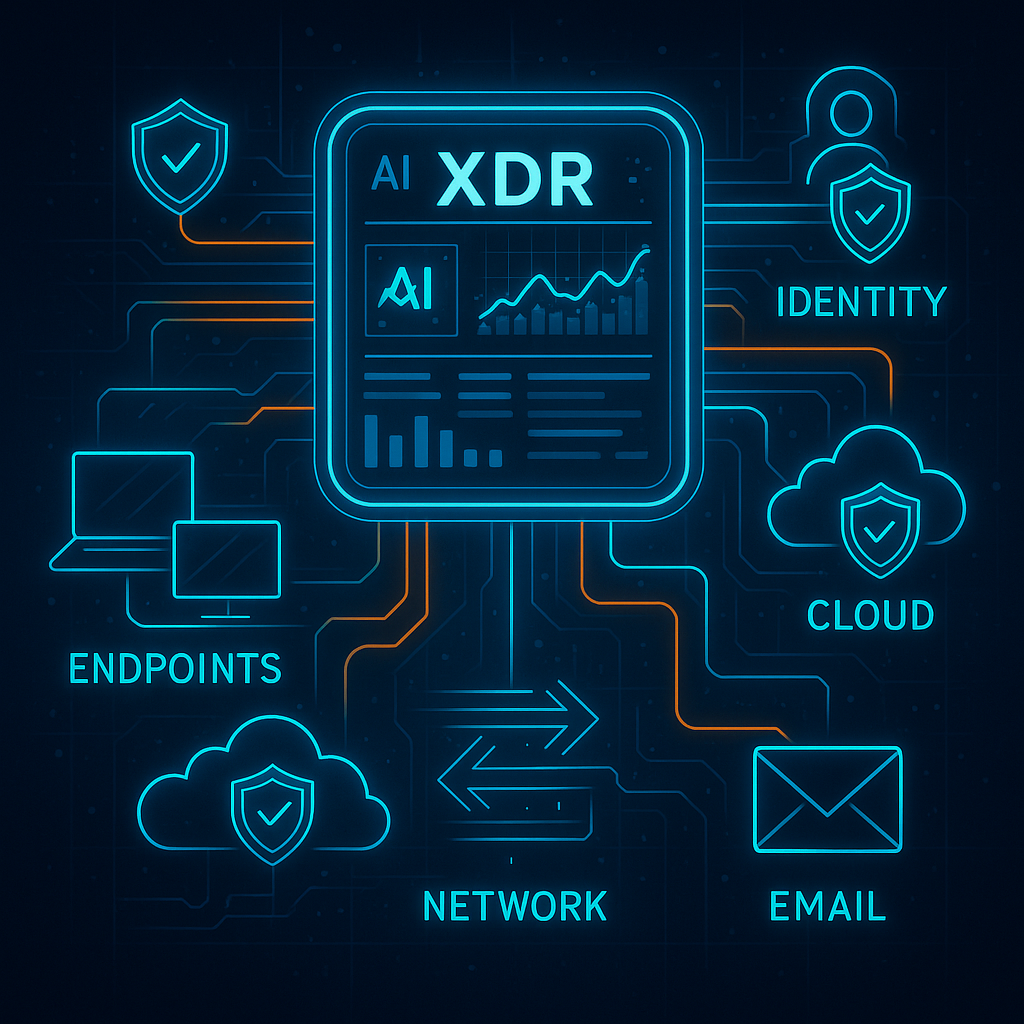
The letter X in XDR stands for Extended. This expansion means that XDR doesn't just monitor endpoints, but also collects and analyzes data from multiple disparate security sources within the organization's infrastructure, including:
-
Endpoints: Computers, Servers.
-
Network: Traffic, firewall logs.
-
Email: attachments, phishing attempts.
-
Cloud environments: Cloud applications, access logs.
-
Identity: Login logs.
In short, XDR is a unified security platform that collects data from all layers of security, uses AI to correlate discrete events, provide a comprehensive context for the attack, and thus enable rapid and automated response across the entire system.
The core components of XDR.
XDR's effectiveness is based on three key pillars that work in harmony to deliver superior protection:
Data Collection and Integration XDR
collects vast amounts of raw data logs and telemetry from all its extended sources and consolidates them into a single central repository, Data Lake. This seamless integration removes barriers between different security tools, allowing data to be analyzed as a unified whole.
Advanced Analytics and Detection
XDR platforms use advanced technologies to detect threats, including:
-
AI and ML : To create natural behavior models for users and devices, and detect any deviation from them as a potential threat.
-
Behavioral Analysis: Focuses on detecting suspicious activity rather than known signatures, enabling it to detect zero-day attacks.
-
Correlation events: To link separate events such as a malicious file in mail, then run it on an endpoint, and then connect to an external network in a single attack story, giving the security team full context.
Unified and Automated Response
XDR provides unified and instant response capabilities from a single platform. Response measures include: automatic isolation of the infected endpoint, mass blocking of suspicious files and IP addresses, and remediation patch for deletion of malicious files. XDR relies heavily on automation to automate initial actions, reducing response time from hours to minutes or seconds.
Key Benefits of Adopting XDR
Technologies Switching to XDR is a strategic investment that provides critical benefits for security teams:
Comprehensive Visibility and Context
XDR provides unified visibility across all layers of security, allowing the security team to see the full picture of an attack from the point of entry to the end target. This full context reduces security noise, allowing analysts to focus on critical threats.
Accelerated Detection and Response
XDRsignificantly reduces the average time to detect MTTD and the average time to respond to MTTR.
|
Scale |
Traditional EDR/SIEM Systems |
XDR Technologies |
|
Average MTTD detection time |
Hours to Days |
Minutes to Hours |
|
Average MTTR Response Time |
Days to Weeks |
Hours to Days |
|
Level of automation |
Low to Medium |
Very high |
Simplified Operations and Reduced Analyst Fatigue XDR
addresses the Analyst Fatigue Challenge by:
-
Reduce alerts: Integrate hundreds of separate alerts into high-quality Incidents.
-
Intelligent automation: Take over routine response tasks, freeing up analysts to focus on complex investigations.
-
Unified Platform: Providing a single user interface for investigation and response.
Superior Protection Against Advanced Threats Advanced
attacks such as sophisticated ransomware use stealth techniques. With its omniscient visibility and ability to link events, XDR can track an attacker's entire trajectory and detect their hidden movements before they can achieve their goal.
XDR vs. EDR and SIEM.
XDR is often confused with other security solutions such as EDR and SIEM security information and event management. It is essential to understand the differences:
-
XDR vs. EDR Detection and Response on Endpoints
-
EDR: Focuses exclusively on hardware endpoints and collects data from them only.
-
XDR: Extends EDR to all data sources network, mail, cloud, and identity. Conclusion: EDR is part of XDR, and XDR provides a broader context for the attack.
XDR vs. SIEM Security Information and Event Management
SIEM, a legacy solution for collecting and analyzing logs, is fundamentally different from XDR:
|
Feature |
SIEM Security Information & Event Management |
XDR Extended Detection and Response |
|
Primary Objective |
Logs collection for compliance and reporting purposes. |
Proactively and uniformly detect and respond to threats. |
|
Data Type |
It depends on logs logs from any source. |
It relies on high-quality Telemetry telemetry data from its security tools. |
|
Analysis |
It is based on manual rule-based correlation rules. |
It is based on artificial intelligence, machine learning, and behavior analysis. |
|
Response |
Very limited, and requires additional tools for response. |
Unified response and automated integration across all control points. |
SIEM is a log collection and analysis system, while XDR is a focused and action-oriented anti-threat system. The two can work together, with XDR sending high-quality incidents to SIEM for compliance purposes.
Real-life scenario: How does XDR detect a complex attack?
Let's imagine a complex attack scenario that traditional tools can't easily detect: a phishing attempt targeting an employee.
-
Email and Endpoint: The employee receives malicious mail and clicks on a link that downloads a malicious file that traditional security tools do not detect.
-
Network and identity: The malicious file starts by connecting to an external C2 command and control server, stealing employee credentials and attempting to log into a sensitive server at an unusual time.
XDR Response:
-
Collect and link: XDR collects email logs, endpoint data, network traffic, and login logs.
-
Intelligent Analysis: AI connects these discrete events with suspicious mail + unknown file + external network connection + abnormal login to create a unified incident with high severity.
-
Automated Response: XDR automatically isolates the employee's computer, blocks the IP address of the C2 server, and revokes credentials.
This stops the attack within minutes.
Challenges of XDR Adoption
Despite the enormous benefits, XDR adoption faces some challenges:
-
Cost and integration: The initial cost of signing up for XDR platforms can be high, and the integration process may require replacing or updating legacy security tools.
-
Vendor Lock-in: Many XDR solutions are closed XDR solutions, which means they work best with security tools provided by the same vendor, and this can limit the organization's resiliency.
-
Need for new skills: XDR requires security teams to develop new skills in unified data analysis, automation, and understanding AI models for threat detection.
The Future of Cybersecurity with XDR
XDR represents the future of cybersecurity. As cloud environments and remote work grow, the need for unified visibility and automated response will become even more urgent. Experts predict that XDR will evolve to include predictive capabilities that use AI not only to detect attacks, but to predict and prevent them before they start.
The ultimate goal is to reach the stage of Autonomous Security, where the platform works around the clock, detecting, verifying, and fully responding to threats without human intervention, transforming the role of a security analyst into a strategy engineer focused on improving the overall security posture of the organization.
Gone are the days when cybersecurity was just a bunch of discrete tools. Today, effective protection requires a unified and intelligent approach. XDR provides this approach, standardizing data, using artificial intelligence to connect dots, and enabling rapid and automated response. The adoption of XDR is an imperative step for organizations seeking to remain at the forefront of defending against evolving cyber threats.