
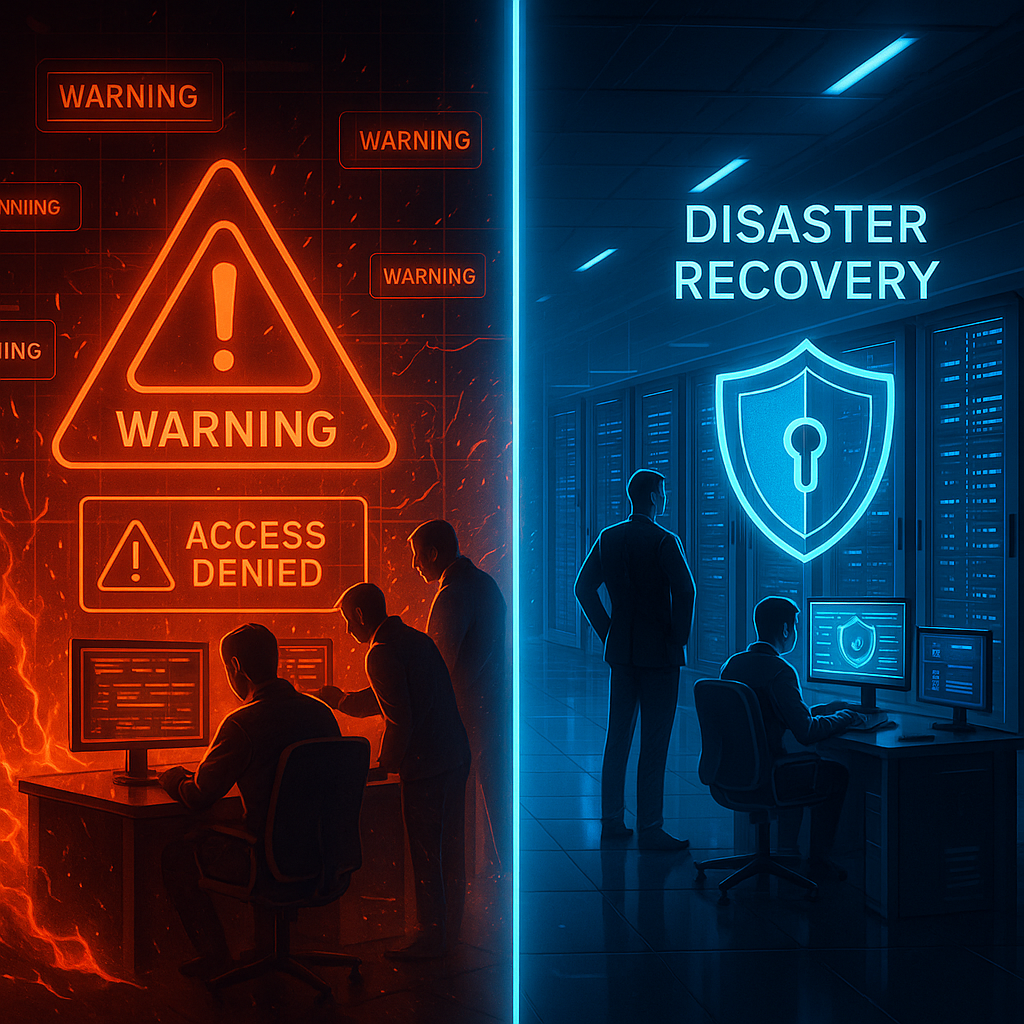
Security Incident Response and Disaster Recovery
Are you ready for the worst?
Imagine you're driving on a highway, and suddenly, you hear a loud explosion. Your tire has exploded! At that moment, it doesn't matter how recent your car was or how skilled you were as a driver; what matters is your immediate reaction and how you'll be able to get back on the road safely. This simple scenario is the closest analogy to what's happening in our complex digital world, where not a day goes by without hearing about a new digital explosion: a hack of a major company, a viral attack that shuts down a hospital, or a sudden crash that wipes out years of business data.
We have become living in a digital age par excellence, where everything, from our personal photos to our financial records, is stored in a world of zeros and ones. With this total dependence, risk preparedness has become not just an option, but an absolute necessity to survive. The question is no longer whether something bad will happen, but when it will happen..
This is where the protagonists of our story come in: Incident Response - IR and Disaster Recovery - DR. These two concepts are a comprehensive contingency plan that ensures you, whether you're an individual or running a large organization, can extinguish the digital fire as quickly as possible, rebuild what it destroyed, and come back stronger than you were.
In this article, we'll delve deep into these two concepts, discovering how any person or organization can build their own shield and prepare a plan for a return to life in the event of an unfortunate event, all in a simple and interesting way that everyone can understand.
Responding to IR security incidents Digital fire extinguishing
Let's say you are in your home and a small fire breaks out in the kitchen. Your immediate reaction is what will determine whether it will end up with minor damage or disaster. This is exactly the essence of IR security incident response.
A security incident is any breach or threat that affects the security of your information, such as a failed hacking attempt, a ransomware infected device, or an accidental leak of sensitive data. The goal of an incident response plan is to act quickly and systematically to minimize damage and contain the threat before it worsens.
Because every minute that passes after the accident is discovered means an even greater loss. You may lose data, lose your customers' trust, or face hefty fines for not complying with the laws. A response plan is your step-by-step guide to handling the situation calmly and effectively.
Stages of an Incident Response Plan (IRP)
An Incident Response Plan can be simplified into six logical stages, which are quite similar to dealing with an actual fire:
-
Preparation
This is the most important stage, and it happens before anything happens. These include building a response team, training them for roles, preparing the necessary tools such as monitoring and backup software, and documenting procedures. In a fire analogy, this stage is to make sure that the fire extinguisher is there, that you know how to use it, and that you have been trained in the evacuation plan. -
Identification
How do you know if there's a problem? This could be through an alert from the monitoring system, a complaint from a user that their device is running slowly, or the discovery of encrypted files. The team must confirm that the incident is real, and determine its type, extent, and affected systems. -
Containment
Once an incident is identified, it should be immediately isolated to prevent its spread. If it's a virus, disconnect the infected device from the network. If it is a breach, the vulnerability used by the attacker must be closed. This step is to close the source of the fire and prevent it from moving to other rooms. This step can be as painful as shutting down a vital server, but it's necessary to prevent a bigger disaster. -
Eradication
At this stage, the root cause of the accident is removed. It's not enough to isolate the device, but it must be cleaned completely, malware removed, and the vulnerabilities that allowed the attack to be fixed. If the fire is caused by a short circuit, the eradication is to repair the damaged wires completely. -
Recovery
Now that the fire has been extinguished and the place has been cleaned up, it's time to get the affected systems back up to work. This is often done by restoring data from a clean backup that has been confirmed to be safe. Restoration should be done gradually and in a controlled manner to ensure that the problem does not return. -
Lessons Learned
This is the final and most important stage for continuous improvement. The team meets to review what happened: Why did the incident occur? Was the response plan effective?
In short: incident response is a tactical process, focused on dealing with the current security threat in the fastest and most effective way.
DR Disaster Recovery: Coming Back to Life
If the response to an incident is to put out a small fire in the kitchen, DR disaster recovery is the plan to rebuild the entire house after it has been destroyed by a storm or earthquake.
A disaster is a large-scale event that causes significant destruction and completely halts business operations. A natural disaster could be a flood, earthquake, or man-made disaster A prolonged power outage, a complete data center failure, a large-scale and devastating cyber attack. The goal of the DRP is to ensure business continuity and get back to work as quickly as possible.
The fundamental difference between an accident and a disaster lies in the extent and impact. An accident can be contained, but a disaster requires moving to an alternative location or using fully backup systems.
Key Concepts in Recovery
To understand recovery, we must know two critical concepts that determine the speed and effectiveness of a plan:
Recovery Point Objective RPO
This concept answers the question: How much data can we afford to lose? If the RPO is one hour, it means that we must ensure that we have a backup that is no more than an hour old. The smaller the RPO , the higher the cost and complexity, but the less data loss.
Recovery Time Objective RTO
This concept answers the question: How long can we stay down? If the RTO is four hours, it means that critical systems must be back up and running within four hours of a disaster. The smaller the RTO, the greater the need for immediate backup systems such as a standby secondary data center, and thus the cost.
Key Pillars of a Recovery Plan
A successful recovery plan is based on three key pillars:
Backup
is the lifeblood of recovery. Without proper backups, there is no recovery plan. The golden rule here is the 3-2-1 rule:
-
3 copies of your original data and 2 backups.
-
2 different storage modes such as local hard drive and cloud.
-
1 Off-site version, preferably in the cloud or in a completely different location.
Alternative Site
When your primary site is completely down, you should have another place to work. This could be a secondary data center, or using cloud computing services that allow you to run your entire systems in another geographic area. This ensures that the local disaster doesn't stop your global business.
Testing
A plan written on paper is worthless unless it is tested. Regular recovery plan drills should be conducted, just as companies conduct fire evacuation drills. Testing detects weaknesses in the plan, ensures that the team knows exactly what to do, and confirms that backups are actually working.
|
Feature |
IR Security Incident Response |
DR Disaster Recovery |
|
Primary Focus |
Deal with specific security threats such as hacks, viruses. |
Restoration of operations after a large-scale disaster such as a complete site downtime. |
|
Main Objective |
Reduce security damage and contain the threat. |
Ensuring business continuity and the return of vital systems. |
|
Time Range |
Immediate and short-term hours to days. |
Medium to long-term days to weeks. |
|
example |
Remove a ransomware virus from a single server. |
Run all of the company's systems in a backup data center after a flood. |
These concepts may seem complex and specific to large companies, but the truth is that everyone needs a response and recovery plan, even on a personal level.
For the individual and the average user:
-
Regular backups are the first line of defense: never put off backing up your important photos and files. Use the 3-2-1 rule. Cloud backups like Google Drive or iCloud are the easiest way to apply an offsite copy rule.
-
Use MFA: This is the most important security step you can take. Even if you steal your password, the hacker won't be able to log in without the additional verification code.
-
Constant software updates: Updates aren't annoying, they're fixes for vulnerabilities. Updating your operating system, browser, and apps is part of the preparation in the personal response plan.
-
What if plan: Think of a worst-case scenario: What if you lose your phone and computer at the same time?
For SMEs:
-
Critical Asset Documentation: What Systems Can Your Company Work Without? Accounting System, Mail Server, Website. Start planning by focusing on these assets first.
-
Invest in automated cloud backup solutions: Don't rely on manual backups. Use reliable cloud solutions that automatically backup and allow you to quickly restore data to achieve low RPO and RTO.
-
Appoint a clear response officer: There should be one person or small team responsible for leading the response and recovery process. Everyone should know who to call when an accident occurs.
-
Training and testing: Don't assume your employees know what to do. Train them on how to recognize phishing emails and how to report incidents. Test your recovery plan at least once a year.
Ultimately, no firewall can prevent every threat, and no plan can predict every disaster. But the difference between an institution that collapses and one that rises quickly lies in how prepared it is.
Security incident response and disaster recovery are not just complex technical terms, but a proactive mindset that recognizes that risk is part of the business in the digital age. Don't wait until the explosion happens to start thinking about a fire extinguisher. Start planning today, and you'll ensure your business or digital life can survive and thrive even in the most difficult of circumstances.
Always remember: preparation is half the battle, and recovery is the other half that guarantees you ultimate victory.