 English
 العربية

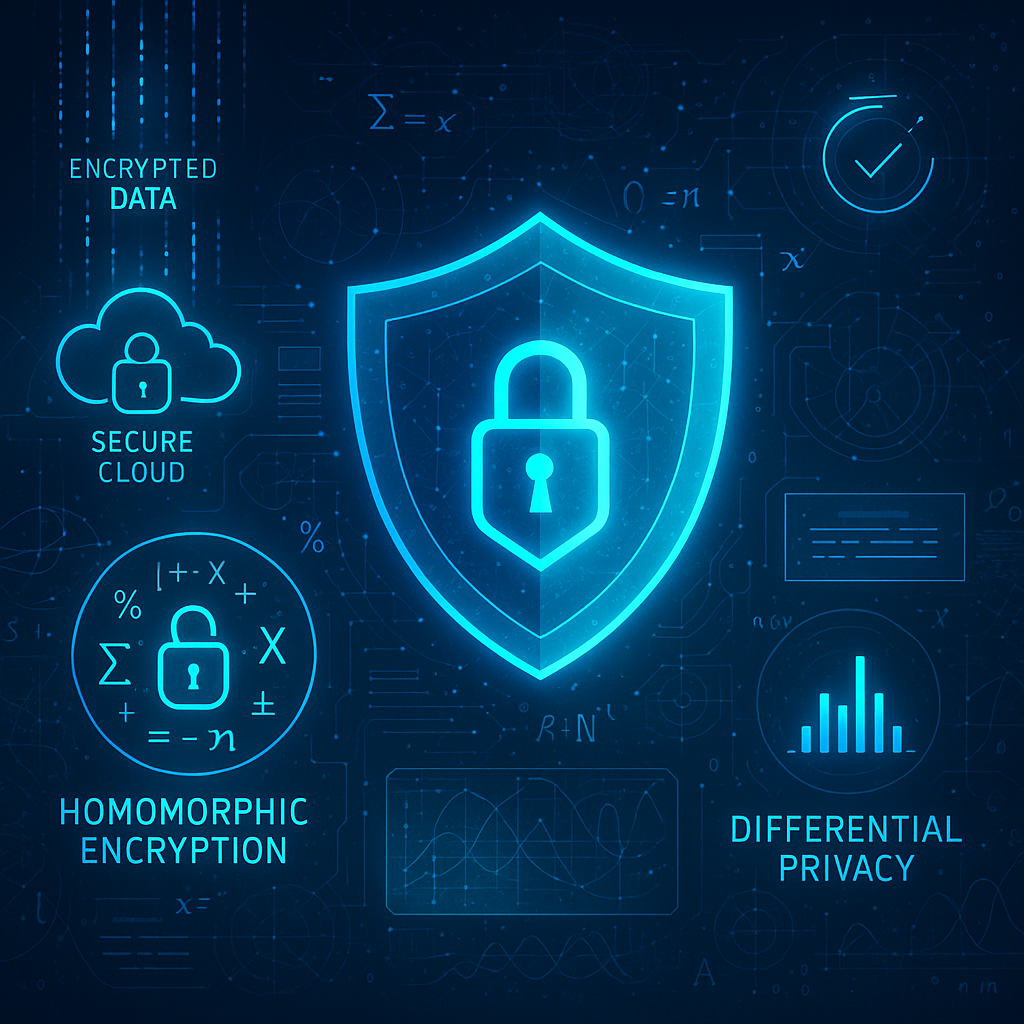
Protecting Privacy Through Privacy Enhancing Technologies (PETs)
We live in the age of data, where digital information has become the fuel that drives the economy and innovation. This big data analysis enables us to develop more effective medical treatments, design smart cities, and build advanced AI systems.
But this digital revolution carries with it a growing obsession: privacy. The more we can collect and analyze data, the more concerns there are about who owns that data and how it's being used. The paradox has become clear: we need to analyze data to make progress, and at the same time we must protect the privacy of individuals as a fundamental right.
This is where the role of privacy-enhancing technologies – PETs comes into play as a radical solution. These technologies are a new philosophy in dealing with data, aiming to achieve the difficult equation: making the most of data without sacrificing the privacy of individuals. It is the bridge that connects the world of data-driven innovation with the world of digital rights.
What are PETs?Privacy Enhancement
Technologies (PETs) can be defined as a set of tools and techniques that allow data to be processed and used in ways that significantly reduce the amount of personal data disclosed, or even eliminate the need for full disclosure.
The basic principle of PETs is to make use of data without seeing it. Rather than relying on absolute trust in the data processor, PETs rely on mathematics and cryptography to enforce privacy, transforming privacy protection from a regulatory issue to a mathematically guaranteed technical one.
These technologies can generally be classified into two main categories: technologies for data protection during use such as symmetric encryption and multi-party computing, and technologies for protecting data during storage and transit such as differential privacy and anonymity.
In the following sections, we'll dive into four of the most important of these technologies, which are the real heroes in the battle for digital privacy.
The Four Heroes: Key PETs Technologies
First: Homomorphic Encryption – HE
Imagine that you have a locked box containing your sensitive data. You want someone to do a math on the contents of that box without unlocking and seeing the numbers. This is exactly what HE symmetric encryption does.
Symmetric encryption is a unique encryption method that allows calculations and analysis to be performed directly on ciphertext encrypted data without having to decrypt it. After the operation is completed, the result is also encrypted, and when decrypted, it is the same result that would have been obtained if the operation had been performed on the original data.
|
Feature |
Simplified Description |
|
The Core Idea |
Perform calculations on encrypted data. |
|
Practicality |
Analyze health or financial data on external cloud servers without the cloud service provider being able to see the original data. |
|
simile |
Give a closed calculator to someone to do the operation, and then you receive the encrypted result and decrypt it yourself. |
Symmetric encryption is an ideal solution for cloud services, as businesses can leverage the power of cloud computing to analyze their data without worrying that the service provider might see or leak that data. Deleted sentence
Secure Multi-Party Computation (SMPC
) Often, multiple parties need to consolidate their data to conduct joint analysis, but neither party wants to disclose their own data to the others. This is where SMPC comes into play, which allows multiple parties to merge their encrypted data and perform a joint analysis on it to get a final result such as an average or pattern, without either party being able to see the data entered by the other parties.
|
Feature |
Simplified Description |
|
The Core Idea |
Collaborate on analysis without revealing individual inputs. |
|
Practicality |
Comparing salaries between different companies to determine the average market without revealing any individual employee's salary or any company's data. |
|
simile |
A group of people participate in a secret vote to find out only the final winner, without knowing each individual's vote. |
SMPC is increasingly used in the financial sector to identify common fraud risks and in the government sector to conduct sensitive statistics and analysis. Deleted sentence
Third Differential Privacy – DP
Although traditional anonymization has long been considered the solution to protect privacy, research has proven that re-identification can be re-identified with relative ease.
DP is a strict mathematical standard that aims to prevent this type of attack by adding thoughtful statistical noise or jamming to the dataset or query results. This noise is enough to mask the contribution of any single individual to the dataset, but it is small enough to maintain the accuracy of the overall analysis.
Differential privacy ensures that the presence or absence of any individual in the dataset does not significantly affect the final result, making it very difficult to infer information about a particular individual.
Differential privacy is one of the most widely used PETs technologies , and is used by giants like Google and Apple to collect usage statistics and analyze users' behavior without compromising their privacy.
Zero-Knowledge Proofs – ZKP
Imagine that you want to prove to your friend that you have a key that unlocks a certain lock without them seeing the key itself. This is the basic concept of ZKP zero-knowledge proofs. These are encryption protocols that allow the validator to verify the authenticity of a certain information to another verified party without revealing anything additional other than the authenticity of the statement.
|
Feature |
Simplified Description |
|
The Core Idea |
Proving something true without revealing the same thing. |
|
Practicality |
Proof that you are over 18 years old without revealing your actual date of birth, or proof that you have paid an invoice without revealing transaction details. |
|
simile |
Proof that you know a password without uttering it, only through system response. |
ZKP is a critical element in the development of Decentralized Digital Identity and in blockchain applications, enabling verification of transactions and personal attributes in a way that maintains complete privacy. Deleted sentence
Why do we need PETs?
Some may be wondering: Isn't traditional encryption and firewalls enough to protect our data?
First, traditional anonymity fails:
Organizations have long relied on anonymization, but advances in data analysis have shown that combining different datasets can easily reveal the identity of individuals. For example, 87% of Americans can be identified by knowing their date of birth, gender, and zip code of their place of residence. PETs, especially differential privacy, go beyond this shortcoming by offering mathematical guarantees of privacy.
Second: Regulatory compliance and strict legislation:
Data protection laws, such as the GDPR in Europe, are becoming stricter. PETs provide organizations with the technical tools needed to comply with these regulations, as they ensure privacy by design, that is, building privacy at the heart of the system rather than adding it later.
Enable secure innovation and collaboration:
In the business world, two competing companies may have valuable data, but they can't combine and analyze it together due to competition or privacy. PETs, especially secure multi-party computing, break down this barrier, opening up new avenues for innovation in critical sectors such as healthcare and finance.
Challenges and Prospects for the Future
Despite the enormous potential of privacy-enhancing technologies, their widespread adoption still faces some fundamental challenges:
|
Challenge |
Description |
|
Performance and efficiency |
Some technologies, such as symmetric encryption, still require high computing power and longer time to perform operations than unencrypted data, making them impractical for some applications that require a quick response. |
|
Technical complexity |
These techniques require a high level of expertise in cryptography and mathematics to implement them correctly. Any minor application error can lead to serious security vulnerabilities. |
|
Lack of standards and uniformity |
PETs are still an emerging field, and clear global standards and standardized tools are needed to streamline the adoption process. |
Bright prospects for the future: The
future looks bright for privacy-enhancing technologies, and there is increasing investment from governments and large companies in research and development, especially in the areas of:
-
Artificial intelligence and machine learning: PETs are increasingly being integrated into AI model training, allowing models to be trained on sensitive data such as patient records without revealing the original data, which is known as privacy-preserving machine learning.
-
DeFi: ZKP zero-knowledge proofs are a key element in building decentralized financial applications that keep transactions confidential.
-
Healthcare: PETs are used to enable researchers to access large, distributed medical datasets to conduct advanced research, while ensuring that patients' identities are fully protected.
Gone are the days when privacy was seen as an impediment to innovation or a luxury that could be sacrificed for progress. Today, thanks to privacy-enhancing technologies (PETs), privacy is an enabled element of innovation.
PETs are the tools that ensure that we can build a digital future that leverages the power of big data without compromising our fundamental right to confidentiality and security. It gives individuals control over their data, gives organizations the ability to innovate and collaborate securely, and gives communities confidence in the digital systems they rely on.
Ultimately, it's not just about data protection, it's about building trust. When people trust that their privacy is technically and mathematically protected, they become more willing to participate in the digital economy, which drives progress. Privacy technologies are not just technologies, they are the promise of a fairer and more trusting digital future.
Add New Comment