
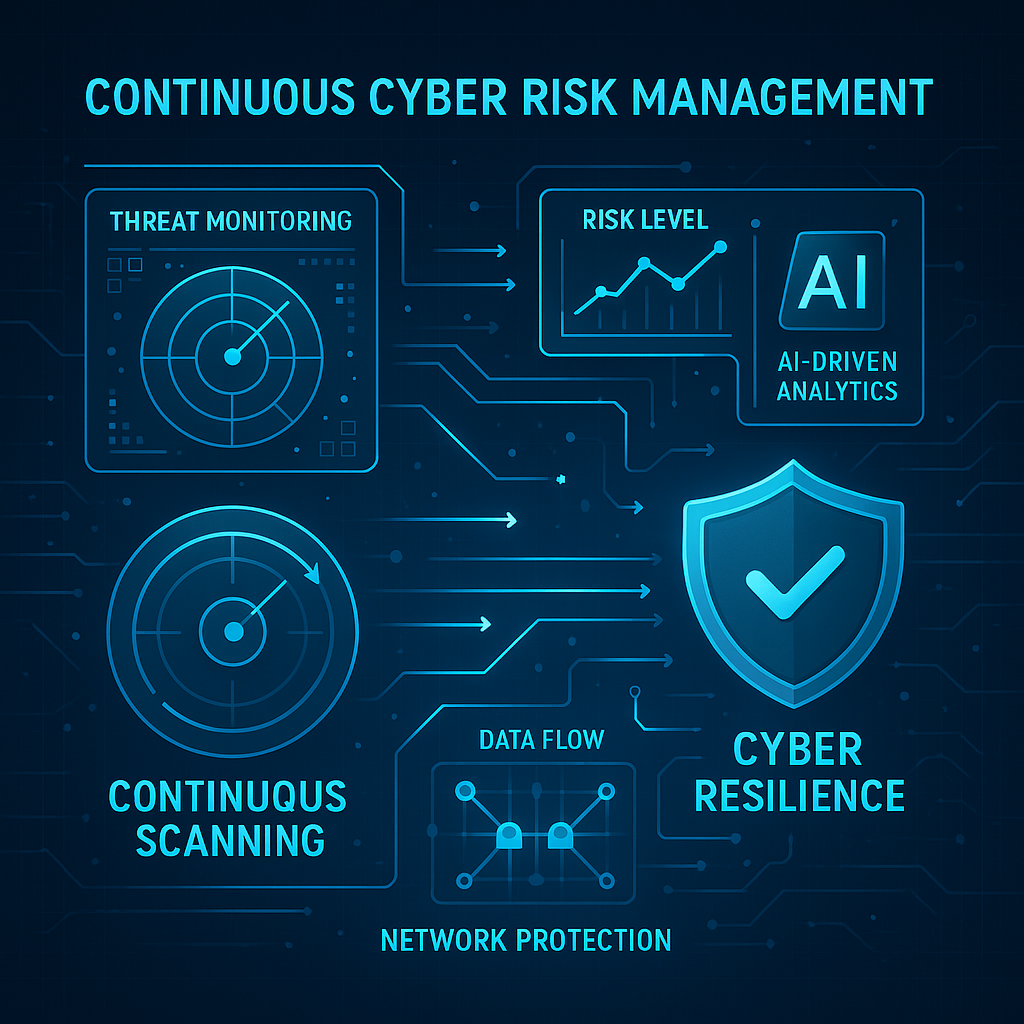
Continuous Cyber Risk Management CRMA
In the era of accelerated digital transformation, data has become the new oil, and technology systems have become the lifeblood of any organization. With this tremendous development, cyber threats are increasing and changing at an unprecedented pace. Cyber-attacks are no longer just distant possibilities, but a daily reality, making cyber risk management a vital task that cannot be postponed or neglected.
Can a report issued six months ago protect your organization today? Cyber risks don't wait, and threats are constantly evolving. The concept of Continuous Cyber Risk Management (CRMA) is emerging as a new and necessary philosophy in the world of cybersecurity.
What is Continuous Cyber Risk Management (CRMA)?
CRMA is an integrated methodology that views risk management not as a cyclical process or endpoint project, but rather as a continuous lifecycle of monitoring, evaluation, response, and adaptation. It's a radical shift from a reactive defense that waits for an attack to happen, to a proactive defense that anticipates and deals with risks in real time.
CRMA can be likened to a navigation system in a modern car. Rather than relying on an old, yearly appraisal paper map, the system uses live data and continuous monitoring to identify congestion, threats, road accidents and vulnerabilities, and suggests alternative routes to immediately address and respond, ensuring you arrive safely and as quickly as possible.
Why Switch to Continuous Methodology?
Switching to CRMA is not a recreational option, but an urgent necessity imposed by the nature of the current digital environment:
|
The Current Challenge |
CRMA Solution |
|
Rapidly evolving threats |
Real-time response: Detects and responds to threats as they arise, reducing the window of vulnerability |
|
Real-time response: Detects and responds to threats as they arise, reducing the window of vulnerability |
Continuous adaptation: Integrate changes in infrastructure, new applications, and cloud expansion into the daily assessment process. |
|
Inadequate periodic evaluations |
Comprehensive and Persistent Vision: Provides a continuous view of the state of risk, rather than a single old time snapshot. |
|
Increased regulatory compliance |
Facilitate compliance: Helps in continuously demonstrating the effectiveness of security controls, facilitating audits and compliance with national and international standards. |
The five pillars of an effective CRM program The
success of a CRM implementation depends on five key pillars that form an integrated risk management lifecycle:
First: Asset Identification & Classification
This is the first and most important step. You can't protect what you don't know. An organization must accurately identify all of its digital assets, including:
-
Data: Customer data, intellectual property, financial data.
-
Systems: Servers, databases, web applications.
-
Devices: Employee devices, IoT devices.
-
Users: Employee accounts, privileges.
These assets should be categorized based on their importance and sensitivity to the business. A high-importance asset requires a higher level of control and protection.
Threat and Vulnerability Assessment
In this phase, potential threats such as ransomware, phishing, internal breaches, and vulnerabilities such as outdated software, misconfigurations, and weak passwords are identified that these threats can exploit.In the context of CRMA, this assessment is done continuously and automatically, using vulnerability inspection tools, periodic penetration tests, and analysis of security event logs to identify any new vulnerabilities as they arise.
Risk analysis and prioritization
Risk is the product of the probability of a threat multiplied by its impact on assets. At this stage, the following steps are taken:
-
Risk measurement: Identify the low, medium, high, critical risk level for each scenario.
-
Prioritization: Not all risks can be addressed at once. Focus should be on high-impact and high-probability risks first.
CRMA uses Key Risk Indicators (KRIs) to act as a risk radar, alerting the security team when a certain indicator exceeds acceptable limits such as a sudden increase in failed login attempts.
Fourth: Risk Treatment
Once the risks are identified and prioritized, the necessary measures are taken to address them. Treatment options include:
-
Mitigation: Apply security controls to reduce the likelihood or impact of a threat such as a system update, implementing multi-factor authentication.
-
Acceptance: Acceptance of a risk if the cost of addressing it outweighs its potential impact.
-
Transfer: Transferring risk to a third party, such as buying a cyber insurance policy.
-
Avoidance: Stopping the activity that causes the danger.
Continuous Monitoring & Revie
This is the pillar that differentiates CRMA from traditional risk management. It ensures that the entire process never stops. This phase includes:
-
Automated control monitoring: Continuous verification that security controls such as firewalls, intrusion detection systems are working effectively as planned.
-
Track Risk Indicators (KRIs): Monitor internal indicators such as the rise in user activity after working hours and external indicators such as the emergence of a new vulnerability globally.
-
Periodic reassessment: Regularly review the threat landscape and internal environment to ensure that risk assessments remain accurate and up-to-date.
How does CRMA actually work?
To understand the power of CRMA, we must see how an organization has shifted from reactive mode to proactive mode:
|
Traditional risk management |
إدارة المخاطر السيبرانية المستمرة CRMA |
|
Evaluation: Once a year or every two years. |
Evaluation: Once a year or every two years. |
|
Data: Based on samples and historical data. |
Data: Based on live data and key risk indicators (KRIs). |
|
Focus: On compliance and meeting regulatory requirements. |
Focus: On value for the business and minimizing potential losses. |
|
Response: Slow, starting after a breach or problem is detected. |
Response: Fast, starting when the KRI alarm appears. |
The role of technology in CRMA
cannot be applied manually. It relies heavily on automation, AI, and ML machine learning to be effective:
-
SIEM Security Information and Event Management Platforms: Collects and analyzes billions of security event logs in real-time, and identifies suspicious patterns that indicate an imminent threat.
-
Vulnerability Management Tools: Continuously and automatically scans the network and systems, classifying vulnerabilities based on their severity and exploitability.
-
GRC Platforms: Provides a centralized dashboard to link risks to security controls, and continuously track compliance status.
-
Cyber Intelligence: Incorporates information about new threats and attacker tactics (TTPs) into the monitoring process, allowing an organization to update its defenses before attacks arrive.
Strategic Benefits of Adopting a CRMA
Adopting a CRM methodology gives organizations a significant competitive advantage beyond just avoiding losses:
Informed Decision Making
When you have a clear and up-to-date view of risk, senior management can make smarter investment decisions. Instead of spending the cybersecurity budget indiscriminately, resources are directed to the areas with the highest actual risk. This ensures the maximum ROSI security investment.
Cyber Resilience
is an organization's ability to survive and recover quickly from attacks. CRMA reinforces this resilience by:
-
Early detection: Reduce Dwell Time for attackers within the network.
-
Rapid Response: Having ready-made and up-to-date response plans based on ongoing assessments.
Building Stakeholder Trust Stakeholder Trust
CRMA demonstrates an organization's commitment to protecting customers, partners, and shareholders' data. This ongoing commitment builds trust and strengthens reputation, which is invaluable in today's business world.
The Challenges of Implementing a CRM and How to Overcome
Them Despite its benefits, implementing a CRM faces a few challenges:
|
Challenge |
How to overcome it |
|
Lack of skills and experience |
Invest in training security teams in automation and analytics tools, or outsource experts. |
|
Lack of skills and experience |
Choose integrated security platforms like SIEM and GRC that can talk to each other, standardizing data sources. |
|
Resisting Cultural Change |
Involve senior management in the CRM process, and make it clear that cybersecurity is everyone's responsibility and not just the IT department. |
|
Noise and false alarms |
Improve the accuracy of KRIs and detection rules, and use AI to filter false alarms and focus on real threats. |
CRMA is not just a new term, it is the future model of cybersecurity. It is an acknowledgement that the threat landscape is constantly changing, and that effective defense must be equally continuous and dynamic.
By adopting CRMA, organizations are moving from a state of periodic evaluation to a state of constant vigilance. This transformation ensures that the organization's digital shield never sleeps, and always remains adaptable and resilient in the face of changing cyber challenges.
It's a non-stop journey, but it's the only one that ensures business sustainability and asset protection in today's digital world.