
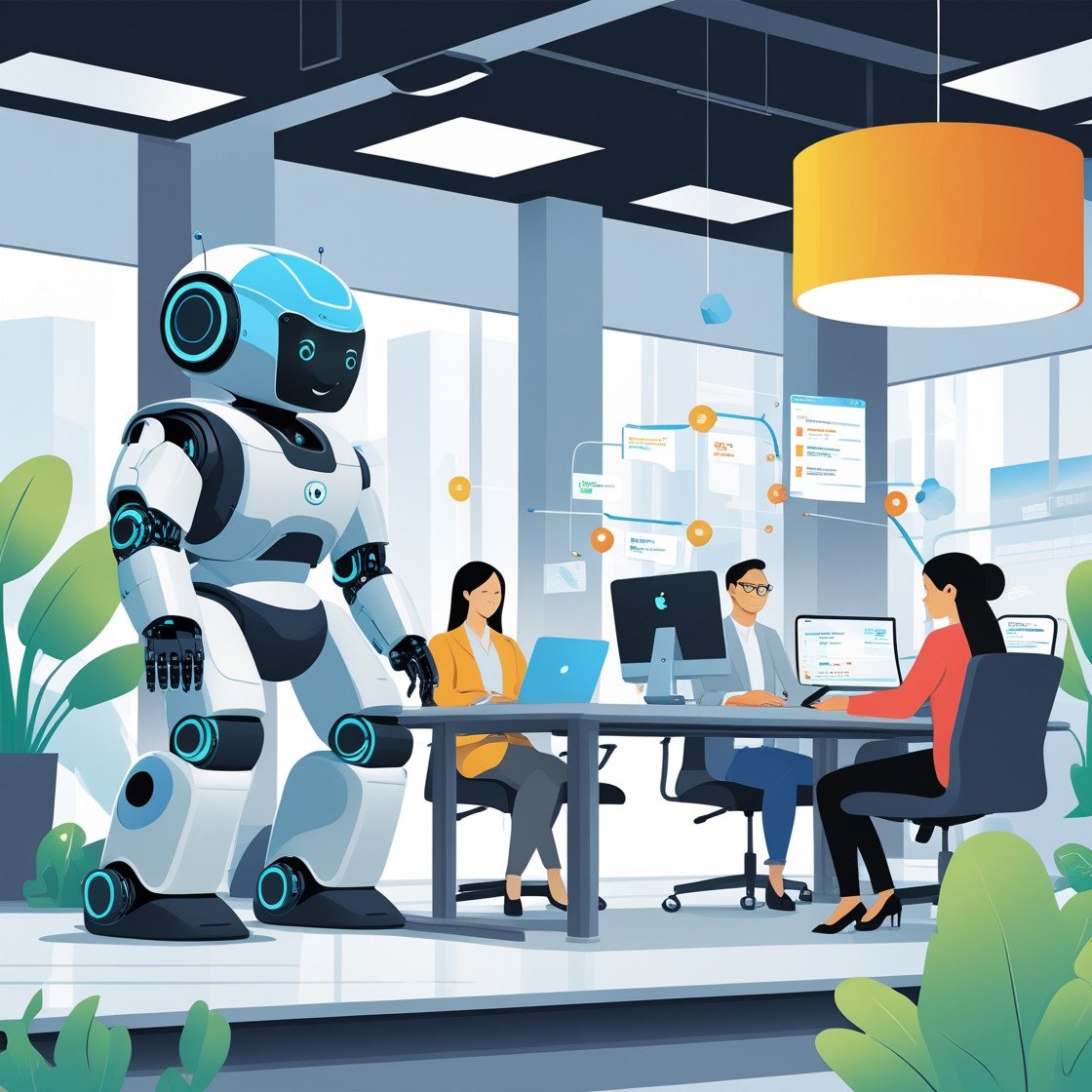
How does AI automate repetitive tasks and increase your team's productivity?
In a world where life is accelerating and work demands are increasing, the search for ways to boost efficiency and productivity has become an urgent necessity rather than a luxury. AI is emerging as a driving force for transformation, offering innovative solutions to the traditional challenges facing teams. Repetitive tasks, which require a lot of effort and time without adding real creative value, have always been a barrier to achieving the full potential of employees and businesses alike. How can this revolutionary technology free teams from the shackles of routine and push them toward greater heights of creativity and productivity?
Artificial Intelligence and Repetitive Task
Automation is a meeting point between AI and traditional automation, going beyond just executing pre-programmed commands to include the ability to learn, adapt, and make decisions based on data. They're not just tools that do the work instead of humans, they're intelligent systems that learn from patterns and improve their performance over time.
There are many repetitive tasks that drain employees' time and energy in different work environments, and AI can effectively intervene to automate many of them. To name a few:
-
Data entry and processing: This task is one of the most time-consuming and prone to human error. AI systems can read data from various sources such as scanned documents, emails, or forms, extract relevant information, and accurately enter it into databases or CRM systems. This not only saves time but also reduces errors significantly.
-
Scheduling and organizing appointments: AI-powered virtual assistants can manage complex appointment schedules, send reminders, and coordinate meetings between different parties, taking into account preferences and availability. This frees employees from the burden of manual coordination that can be cumbersome.
-
Responding to frequent queries Customer service: Chatbots use AI-powered chatbots and virtual assistants to handle a large number of recurring customer queries around the clock. These systems can provide instant answers, guide customers, and even resolve simple issues, reducing stress on human customer service teams and allowing them to focus on more complex cases that require human intervention.
-
Raw data analysis and reporting: AI can process vast amounts of raw data, identify patterns and trends, and generate customizable raw reports. This speeds up the process of gaining insights and enables teams to make informed decisions faster.
-
Email management and categorization: AI tools can categorize emails, prioritize them, and even formulate initial responses to repeated messages, helping employees manage their inboxes more efficiently.
Freeing employees from these routine and repetitive tasks is not just a saving of time, it is an investment in human capital. When employees don't have to spend long hours on boring and consuming work, they can direct their energy and focus toward tasks that require creativity, critical thinking, complex problem-solving, and value-added human interaction. This transformation not only boosts productivity, but also increases job satisfaction and contributes to a more motivated and creative work environment.
Increasing team productivity with AI
AI is not only about automating routine tasks, but also extends to enhancing the overall productivity of the team through several vital aspects:
-
Improve efficiency and reduce human error: When AI systems take on repetitive tasks that require high accuracy, they significantly reduce the likelihood of human error. This leads to improved output quality, reducing the need for rework, and thus increasing overall efficiency. For example, in the field of data entry, AI can process vast amounts of information with precision beyond human ability, ensuring data integrity and reliability.
-
Accelerate work and decision-making: AI provides the ability to process and analyze data at breakneck speed, enabling teams to gain valuable insights in record time. This acceleration of the information cycle enables more informed and timely decision-making, which is critical in rapidly changing business environments. Whether it's analyzing market trends, evaluating the performance of marketing campaigns, or even prioritizing tasks, AI provides the necessary support for teams to be more agile and responsive.
-
Boost employee creativity and innovation: By freeing employees from routine loads, AI gives them the space and time to focus on tasks that require creative thinking, solving complex problems, and developing new ideas. Employees are able to explore new opportunities, develop their skills, and contribute more to strategic initiatives that drive growth and innovation in the organization. This shift from routine work to creative work enhances the value of the employee and makes them a true partner in success.
-
Improve employee satisfaction and reduce burnout: Repetitive and tedious tasks are often a source of burnout and boredom, negatively impacting employee morale and job satisfaction. When these tasks are automated, employees feel more appreciated for their efforts, as their energy is directed towards more challenging and exciting work. This not only increases their satisfaction but also reduces burnout and burnout rates, leading to a healthier and more productive work environment.
Practical examples: Many companies around the world are already reaping the benefits of adopting AI to increase their productivity. In the customer service sector, large companies are using AI-powered chatbots to handle millions of queries per day, reducing wait times and dramatically improving the customer experience, while human staff are focusing on complex cases that require empathy and personalized solutions. In HR, AI tools are used to automate the initial screening of resumes, saving recruitment teams long hours of manual work and allowing them to focus on evaluating the most qualified candidates. It is also used in the analysis of sales and marketing data to identify patterns and predict future needs, enabling teams to formulate more effective strategies.
Challenges and ways to overcome them
Despite the enormous benefits that AI offers in automating tasks and increasing productivity, its adoption is not without challenges that organizations must deal with intelligently and wisely to ensure a smooth and efficient transition:
-
Employee fears of job loss: This challenge is one of the most prominent concerns that come up when talking about AI. Employees fear that machines will replace them, leading to the loss of their jobs. To overcome this, leaders must communicate transparently with their teams, and make it clear that AI is not a substitute for humans, but rather a tool to enhance their abilities and free them to take on more valuable and creative tasks. It should be emphasized that AI will change the nature of jobs and not necessarily eliminate them, creating new opportunities that require different skills.
-
The importance of employee training and onboarding: As the nature of work changes, it becomes necessary to rehabilitate and train employees in the new skills required by the AI-powered work environment. Companies should invest in training programs that focus on developing digital, analytical, and creative skills, as well as understanding how to interact and collaborate with AI systems. This investment not only ensures the continuity of employees in the labor market, but also enhances their ability to contribute effectively to the new era.
-
The need for a clear strategy for applying AI: AI cannot be adopted randomly. It takes a clear and thoughtful strategy that outlines the goals, the tasks to be automated, the right tools and techniques, and how to integrate AI into the current workflow. This strategy should include change management plans, impact assessment, and ensuring compliance with data and privacy regulations and laws.
-
Data quality and security: The performance of AI systems is highly dependent on the quality of the data they are fed with. Inaccurate or incomplete data can lead to misleading results or wrong decisions. Therefore, organizations must pay special attention to data collection, cleaning, organization, and ensuring its security and privacy, especially with the growing concerns about data leaks and cyber breaches.
Overcoming these challenges requires a holistic approach that combines technology, strategy, and, most importantly, a focus on the human element. Building a work culture that embraces change, encourages continuous learning, and believes that AI is a partner rather than a competitor is the key to making the most of this technological revolution.
The Future
of Artificial Intelligence in the workplace is still in its infancy, and the future holds with it deeper and more exciting transformations. With the continuous development of AI capabilities, we expect it to become an indispensable partner in every aspect of the business, reshaping the nature of the jobs and skills required.
-
Changing the nature of jobs: AI will not completely eliminate jobs, but will change their nature. Routine and increasingly repetitive tasks will move to intelligent systems, while the need for unique human skills such as creativity, critical thinking, emotional intelligence, and the ability to solve complex problems that require deep contextual understanding will increase. Employees will become more focused on supervisory, strategic, and creative roles, leveraging AI as a powerful tool to enhance their capabilities.
-
Human-machine collaboration: Human-machine collaboration will become the dominant model in the future. AI will not just be a tool, but a smart partner that provides support, analyzes data, and makes recommendations, while humans make the final decisions and add a human and creative touch. This collaboration will lead to unprecedented levels of efficiency and innovation.
-
Personalize Job Experience: AI can help personalize each employee's job experience, by analyzing work patterns, identifying strengths and weaknesses, and providing personalized recommendations for training and development. This will contribute to building stronger and more diverse teams, where the potential of each individual is maximized.
The future that AI is painting is one that does not diminish human value, but rather enhances it. It is a future that frees us from the shackles of routine and opens new doors for creativity, innovation, and self-actualization in a smarter and more humane work environment.
Today, AI is not just a promising technology, it is a tangible reality that is reshaping work environments around the world. With its superior ability to automate repetitive tasks, AI frees teams from routine loads, allowing them to focus on value-added activities that require critical thinking, creativity, and innovation. This shift not only leads to a significant increase in efficiency and productivity, but also contributes to improved employee satisfaction and reduced burnout, creating a more motivating and positive work environment.