
ERPs Simply :
In today's business world, success no longer depends only on the quality of the product or service you provide, but on how you manage every detail of your company. The accountant doesn't know what's going on in the store, the salesperson sells products that aren't available, and the manager is overwhelmed with piles of contradictory paperwork and reports that don't give a clear picture of the company's real situation. If this picture is familiar You're not alone, and the solution is to identify the digital lifeguard known as an ERP system.
What is an ERP system simply?
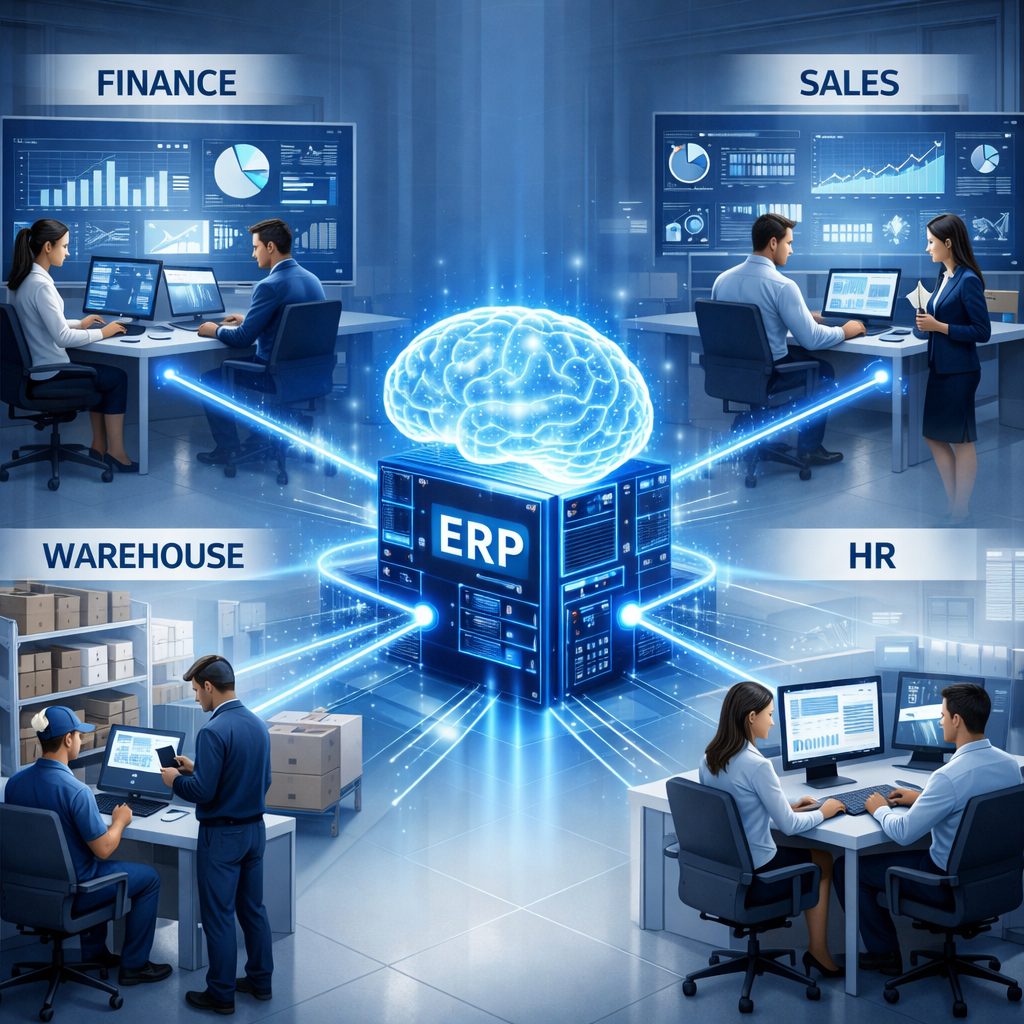
ERP is an acronym for Enterprise Resource Planning, and in Arabic it means Enterprise Resource Planning. But beyond the dry technical jargon, imagine that your company is a human body. In this body, different departments such as accounting, sales, warehousing, and human resources are vital organs, and an ERP system is the central nervous system that connects all these organs to each other, transmitting signals and information between them at lightning speed. Quite simply, it is one integrated computer program that collects all the data of the company in one place. Instead of each department having its own program or separate Excel files whose information may be lost or conflicted, everyone shares one system and one database. When a sales person completes a transaction, the accountant immediately knows that there is a new income to be recorded, the warehouse manager knows that the quantity is low and more needs to be ordered, and the general manager can see all these updates in the moment from his mobile phone while he is at home or on a business trip.
From paper notebooks to the digital cloud,
these sophisticated systems didn't suddenly appear, but were the result of decades of technological advancement. In the 1960s, large companies used only large computers to calculate inventory quantities and avoid running out of materials. In the 1970s, it evolved to become smarter, with systems that helped plan materials for manufacturing processes, to ensure that production lines didn't go down. But the real revolution came in the 1990s, when developers realized that a company wasn't just a warehouse and a factory, it was an entity An integrated needs to link finance with human resources with sales. This is where the term ERP as we know it today came into being. With the beginning of the new millennium, the biggest transformation took place: cloud systems. Previously, owning an ERP system required private rooms full of servers and a team of engineers to maintain them, making it the preserve of giant companies. Today, thanks to cloud computing, a small shop owner or startup can use the world's most powerful online technologies for a simple monthly subscription, just like they subscribe to movies or music services.
Why do successful companies insist on using an ERP system?
The employer of my company that works well with paper and pen or simple Excel files may ask, why do I need to invest money in a new system? The answer lies that real growth requires a strong system to support it, and here are the top reasons why ERP is an indispensable necessity:
-
Eliminate human errors: When an employee manually transfers data from a paper invoice to an Excel file, and then another employee transfers it to a financial report, the probability of error increases significantly. An ERP system automatically transfers data between departments, ensuring extreme accuracy and protecting the company from financial losses that may result from minor errors in calculations.
-
Lightning-fast decision-making: In the world of trading, time is money. Can you wait a week for an accountant to collect your profit and loss reports? With an ERP, you can get an accurate and comprehensive report at the click of a button, at any moment. This speed enables you to seize opportunities or fix problems before they get worse.
-
Wasted cost savings: The system may seem expensive to buy, but it's really a money-saving machine. It helps you detect stagnant products in stock to reduce their purchases, prevents thefts or financial manipulation thanks to strict controls, and reduces the need for an army of employees to perform routine administrative tasks that the system can do automatically.
-
Compliance with laws and taxes: In our Arab region, compliance with VAT and e-invoice has become mandatory. An ERP system that is compliant with local laws such as a restrictions system automatically generates tax invoices and calculates zakat and income, which avoids heavy legal fines for the company.
-
Improve customer experience: When an angry customer calls asking about their order being delayed, and instead of telling them I'll check back and call you back, you can immediately let them know where the package is, its status, and when it's expected to arrive. This level of professionalism builds invaluable trust with your customers.
ERP System Components: An
ERP system consists of several modules, which you can imagine as Lego pieces that you can put on top of each other to suit the size and needs of your company:
-
The Finance and Accounting Unit: It is the beating heart. Every Halala enters or exits, manages bank accounts, and issues balance sheets and profit and loss reports without complex human intervention.
-
Warehouse and Supply Chain Management Module: Monitors the movement of every item in your warehouse. Tells you when you should order new quantities, and helps you keep track of expiry dates for food or medical products.
-
HR Unit: You take care of your most precious possessions, your employees. You manage their files, paychecks, vacations, and even their annual performance appraisals. It also ensures that salaries are paid on time accurately and without errors in calculating overtime or overtime.
-
Sales & Customer Relations (CRM) unit: The company's eye on the market. It follows the customer journey from the first moment of interest in your product until it becomes a permanent customer. It helps you send specialized offers and understand your customers' buying behavior.
-
Project Management Module: If your company is in contracting or consulting, this module helps you keep track of each project's schedule, distribute tasks to employees, and monitor the budget allocated for each stage.
How does magic work? The real
secret behind the power of ERP is what experts call a single source of truth. In traditional companies, you may find a copy of the customer's data at the sales department, a different copy at the delivery department, and a third copy with the accounting. This dispersion leads to disasters. In an ERP system, there is only one central database. When information is updated in any department, it speaks immediately in all the other departments.
Practical example: Let's say you own a furniture store. A customer purchased a table from your website.
-
Immediately, the system deducts a table from the storage unit.
-
The Finance Unit records a new revenue and issues an electronic invoice to the customer.
-
The delivery unit receives a notification that there is a new order that needs to be shipped.
-
The purchasing manager sees that the table stock has reached the minimum, so the system proposes a new purchase order from the supplier.
All of this happens in a matter of seconds without any employee picking up the phone to tell the other what happened.
Types of ERP systems: How to choose the one that works best for you?
There is no one-size-fits-all system, as what Aramco needs is very different from what a barbershop or restaurant needs. Therefore, the systems are divided into:
First in terms of installation method:
-
On-Premise Local System: You buy the software and place it on special devices within your company. It has a complete privacy feature, but its disadvantage is that it is very expensive and requires constant maintenance.
-
Cloud ERP: It's the most popular right now. You don't need hardware, just a web browser. The provider is the one who cares about security and updates, and you only pay for what you use.
Second, in terms of sectoral specialization:
there are general systems that are suitable for any trade, and there are highly specialized systems. For example, ERP systems for hospitals focus on patient records and doctors' appointments, while factory systems focus on machinery, production lines, and waste of raw materials.
Challenges you may face and how to overcome
them Despite all the benefits, moving to an ERP system is not just a software installation. It's a change in work culture. The biggest challenge you may face is resisting change from employees who are used to the old ways.
Golden tip: Don't impose a system, involve your employees in choosing it, explain to them how it will save them hours of tedious routine work, and provide them with intensive and simplified training.
Also, it is a common mistake to try to apply all the system modules at once. It's best to start with the most important units like finance and warehouse, and then gradually expand over time.
We are now entering the era of artificial intelligence in business management. Future ERP systems will not just record what happened, but will predict what will happen. The system will start sending you alerts such as: Based on the sales pattern of the past three years, we expect demand for this product to increase by 20% next month, are we ordering an extra quantity now?. Or there is a frequent delay from this supplier, we suggest you look for an alternative to ensure that production continues.
An ERP system is not just a technical tool, it's your company's mind that never sleeps. It's the investment that transforms your business from a shop run by chance to an organization run by science and accurate data. In today's unforgiving market, the use of technology is no longer a luxury that can be postponed, but rather a prerequisite for survival, growth, and competition.
Whether you're running a small business from your home or leading a medium-sized business that aspires to go global, there's always an ERP system that fits your size and budget. Start exploring the options today, the digital future has already begun, and only companies that adopt these systems will lead the way in the years to come.