
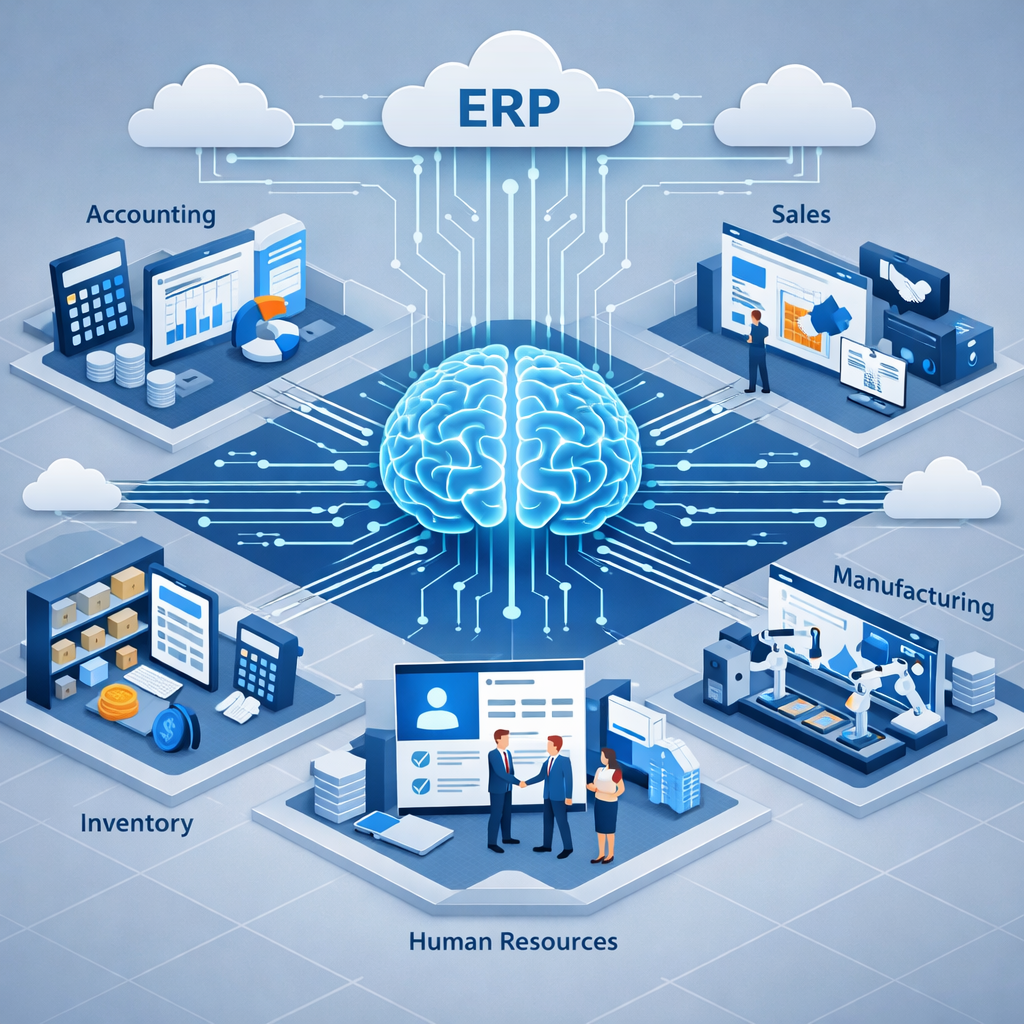
ERP System is the mastermind for the success of modern organizations
What is an ERP system?
Imagine that the human body works with amazing efficiency; each organ knows its role, and everyone communicates through one central nervous system. This device ensures that information is transmitted quickly and accurately, and that decisions are made based on a complete picture of the situation.
In the business world, this central nervous system is what is known as the ERP system, which is an abbreviation of the English term Enterprise Resource Planning.
For non-specialists, an ERP system can be simply defined as a massive, unified computer program that acts as a central platform for collecting, managing and interpreting data from all of an organization's core business activities. Whether your company is a huge factory, a retail store, or a service company, an ERP system is the tool that connects separate departments such as accounting, warehousing, sales, and human resources together, and makes them work as one integrated team.
An ERP system has gone beyond being just a technical tool to become a business strategy aimed at improving efficiency and reducing costs. In this article, we'll explore this system, how it evolved, what its components are, and why it's become a necessity for any organization seeking to grow in the digital age.
The ERP system did not suddenly appear, but went through long stages of development:
-
Beginning 1950s and 1960s: Focus on inventory management and raw material tracking.
-
MRP - 1970s: It evolved to include MRP and was aimed at manufacturing companies.
-
MRP II – 1980s: Expanded to include other aspects of manufacturing such as scheduling and finance.
-
The Emergence of ERP - 1990s: The term ERP emerged to encompass all departments and functions in the company, human resources, finance, and sales.
-
Modern ERP 21st century: shifting towards cloud ERP, adding advanced technologies such as artificial intelligence and big analytics.
How does an ERP system work?
The core of the power of an ERP system lies in a simple but revolutionary principle: a centralized unified database.
In companies that don't use an ERP, each department has its own software, which leads to duplication, data inconsistencies, and slow decision-making.
An ERP system solves this problem by providing a single common database. When a sales person registers a new order, the inventory is automatically updated in the Warehouses section, and an invoice is automatically generated in the Accounting section. This integration ensures that all employees are looking at the same accurate and up-to-date information in real-time, which is known as the only source of truth that everyone can rely on.
Core Sections Modules in an ERP
System An ERP system consists of a set of modules, each module designed to manage a specific business function. Companies can choose the modules they need, but the following modules are the most common and important:
|
Module |
Simplified Description |
Its importance to the company |
|
Finance & Accounting |
Manage general accounts, accounts payable and receivable, budget, and financial reporting. |
Track financial performance accurately and ensure compliance with laws. |
|
HR Management |
Track employee data, payroll, vacations, and attendance. |
Manage employees efficiently and ensure that salaries are paid on time. |
|
SCM Supply Chain Management |
Track the flow of goods from suppliers to customers, including procurement and logistics. |
Ensuring the availability of raw materials and delivering products to customers in the fastest and least expensive way. |
|
CRM |
Record customer interactions, track sales, and manage marketing campaigns. |
Build strong relationships with customers and increase sales. |
|
Manufacturing & Production |
Production planning, scheduling of processes, and management of product quality and costs. |
Improve the efficiency of production lines, reduce waste and ensure quality. |
|
Inventory Management |
Track inventory levels, identify reorder points, and manage warehouses. |
Avoid running out of stock or accumulating excess inventory. |
The Big Five Benefits of an ERP System Why is it a Necessary Investment?
Investing in an ERP system is not just buying software, it's an investment in a company's future and competitiveness. Its benefits are manifested in five main axes:
-
Enhance operational efficiency and automate tasks
ERP system designed to automate routine and repetitive tasks. Instead of manually entering data into different systems, the system does so automatically once it is entered. This significantly reduces human error and speeds up the completion of workcycles, saving employees time and effort to focus on strategic tasks. -
Making better decisions and faster data in real-time
In a rapidly changing business world, getting the right information at the right time is crucial. The ERP system provides comprehensive dashboards and reports that collect data from all departments, giving management a comprehensive and real-time view of the financial situation, inventory, and sales performance. The single source of truth ensures that decisions are based on reliable and standardized data, and modern systems use historical data to predict future needs, supporting strategic planning. -
Improve customer service and satisfaction
Integration between sales, inventory, and customer service departments leads to a better customer experience. The customer service agent can instantly access the customer's order history and shipping status from a single screen, enabling them to resolve issues quickly. The sales department can also provide accurate promises of delivery times based on real-time visibility of the inventory level and production schedule. -
Compliance and Financial Control Companies
are subject to strict financial and tax laws and regulations. An ERP system provides a clear audit trail for each transaction, making it easier for auditors to review records. The system can also be configured to automatically comply with local and international accounting standards, reducing the risk of fines and legal issues. -
Unify processes and apply best practices
When implementing an ERP system, the way the company works is standardized across all departments and branches. The system requires everyone to follow the same standard best practices built into it, reducing clutter. This standardization makes it easier to open new branches or expand into new markets, because the business model and procedures are standardized and documented within the system.
Types of Traditional vs. Cloud ERP
Systems When a company decides to adopt an ERP system, one of the most important decisions is to choose the type of hosting:
|
Feature |
On-Premise |
Cloud ERP |
|
Hosting Location |
The company's own servers within the company's headquarters. |
Difficult and slow requires the purchase of additional servers. |
|
Initial Cost |
Very high server purchase, licenses, installation. |
Low monthly or annual subscription fees. |
|
Maintenance & Modernization |
Corporate responsibility needs a specialized technical team. |
The service provider's responsibility is updated automatically. |
|
Arrival |
Often restricted to the company's internal network. |
From anywhere, anytime online. |
|
Flexibility and Scalability |
Difficult and slow requires the purchase of additional servers. |
Easy and fast increase the number of users or units with the push of a button. |
The current trend is Cloud ERP, especially for small and medium-sized businesses, due to their low initial cost, ease of maintenance, and high flexibility in scaling.
ERP System Application Journey Challenges and Success
ERP system implementation is a huge and complex project, not just a software installation process. The application journey can be summarized in four main phases:
-
Planning and selection: Identifying the needs of the company, choosing the right system such as SAP, Oracle, Microsoft Dynamics, Odoo based on size and budget, and choosing a specialized executive partner.
-
Design and configuration: Adapt the system to suit the company's business processes, and transfer historical data migration from legacy systems to the new system with high accuracy.
-
Testing and training: Conducting thorough tests to make sure the system is working properly, and training employees to use it, which is a critical stage for project success.
-
Kick-off and support: Actual start with the new system, and provide ongoing technical support to employees.
The biggest challenge in any ERP project is not technical, but human. Employees tend to resist change. Therefore, change management, continuous communication with employees and their involvement in the implementation process is a critical factor for the success of the project.
The future of AI ERP at the heart of the enterprise The future of
ERP systems is moving towards smarter and more interactive systems. The system is no longer just a data logger, but an analyst, forecaster, and personal assistant:
-
AI and ML: These technologies are used to improve demand forecasting, fraud detection, automate data entry, and improve supply chain efficiency. The system can automatically predict the optimal time to order raw materials.
-
IoT: Connect factory and warehouse devices directly to an ERP system, where sensors send inventory or machine status data directly to the system, providing instant and accurate visibility.
-
Mobile ERP : Access to the system via mobile apps has become key, allowing employees to work from anywhere.
In conclusion, it can be said that an ERP system is the backbone that modern organizations rely on to achieve efficiency and growth. It's not just sophisticated accounting software, it's a comprehensive system that enforces discipline, unifies vision, and turns raw data into smart decisions. For any company that aspires to expand or improve its profitability, adopting an ERP system is no longer an option, but a strategic necessity.